
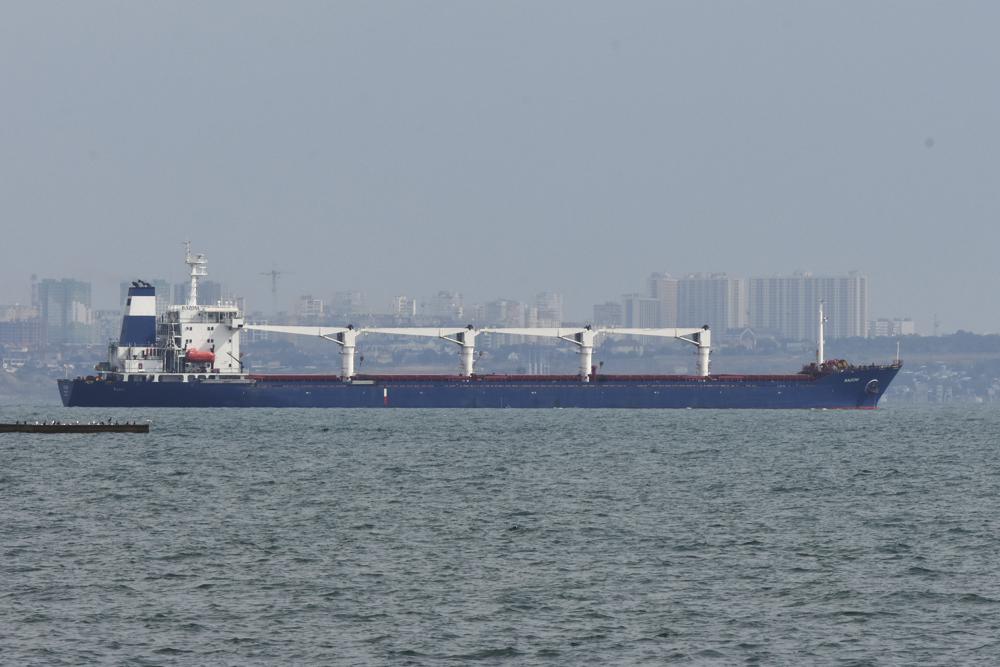
The bulk carrier Razoni starts its way from the port in Odesa, Ukraine, Monday, Aug. 1, 2022. According to Ukraine’s Ministry of Infrastructure, the ship under Sierra Leone’s flag is carrying 26 thousand tons of Ukrainian corn to Lebanon. The first ship carrying Ukrainian grain set off from the port of Odesa on Monday under an internationally brokered deal and is expected to reach Istanbul on Tuesday, where it will be inspected, before being allowed to proceed. (AP Photo/Michael Shtekel)Click to copyRELATED TOPICS
KYIV, Ukraine (AP) — The first ship carrying Ukrainian grain set out Monday from the port of Odesa under an internationally brokered deal to unblock the embattled country’s agricultural exports and ease the growing global food crisis.
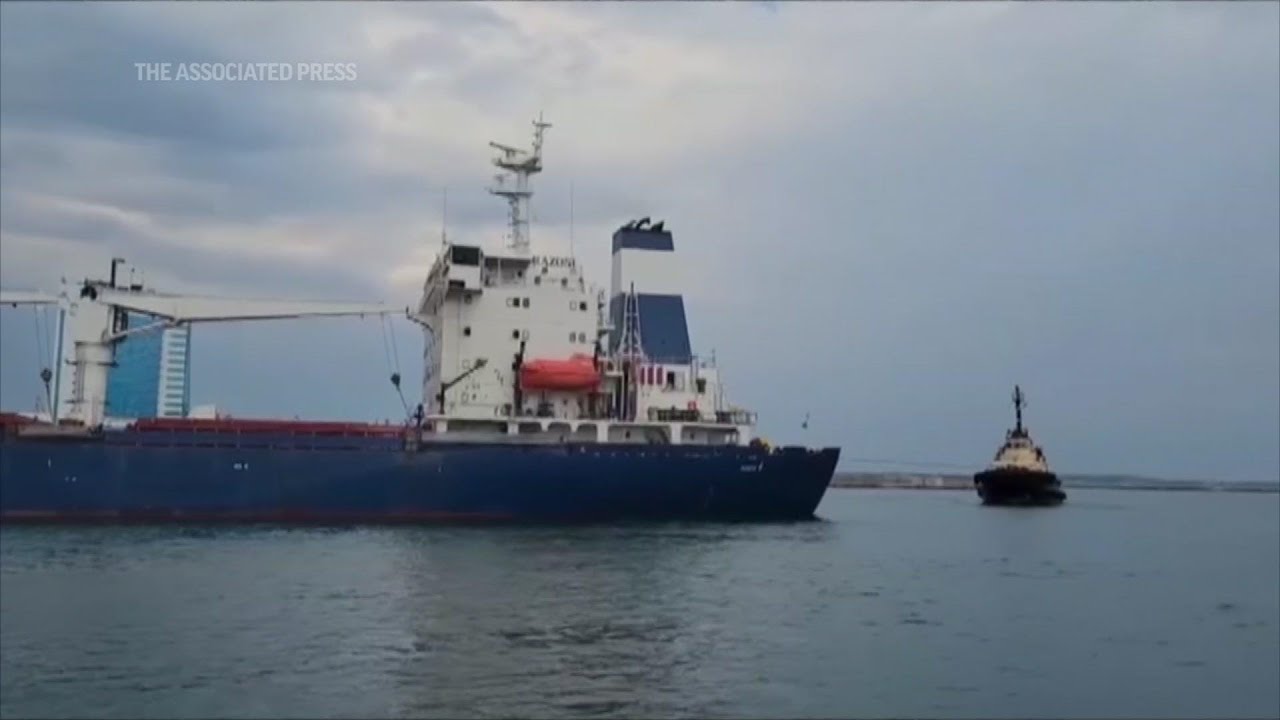
The Sierra Leone-flagged cargo ship Razoni sounded its horn as it slowly departed with over 26,000 tons of corn destined for Lebanon.
“The first grain ship since Russian aggression has left port,” Ukrainian Minister of Infrastructure Oleksandr Kubrakov declared on Twitter.
Russia and Ukraine signed agreements in Istanbul with Turkey and the U.N. on July 22, clearing the way for Ukraine to export 22 million tons of grain and other agricultural products that have been stuck in Black Sea ports because of Russia’s invasion of Ukraine more than five months ago. The deals also allow Russia to export grain and fertilizer.
As part of the agreements, safe corridors through the mined waters outside Ukraine’s ports were established.
Ukraine and Russia are major global suppliers of wheat, barley, corn and sunflower oil, with the fertile Black Sea region long known as the breadbasket of Europe. The holdup of food shipments because of the war has worsened rising food prices worldwide and threatened hunger and political instability in developing nations.
“Today Ukraine, together with partners, takes another step to prevent world hunger,” Kubrakov said.
In Moscow, Kremlin spokesman Dmitry Peskov hailed the ship’s departure as “very positive,” saying it would help test the “efficiency of the mechanisms that were agreed to during the talks in Istanbul.”
Under the agreements, ships going in and out of Ukrainian ports will be subject to inspection to make sure that incoming vessels are not carrying weapons and that outgoing ones are bearing only grain, fertilizer or related food items, not any other commodities.
The Razoni was expected to dock early Wednesday in Istanbul, where teams of Russian, Ukrainian, Turkish and U.N. officials were set to board it for inspection.
More ships are expected to leave from Ukraine’s ports through the safe corridors. At Odesa, 16 more vessels, all blocked since Russia’s invasion on Feb. 24, were waiting their turn, with others to follow, Ukrainian authorities said.
But some shipping companies are not yet rushing to export food across the Black Sea as they assess the danger of mines and the risk of Russian rockets hitting grain warehouses and ports.
U.N. Secretary-General Antonio Guterres, who proposed the grain deal in April, said the Razoni was “loaded with two commodities in short supply: corn and hope.”
“Hope for millions of people around the world who depend on the smooth running of Ukraine’s ports to feed their families,” he said.
In an interview with Turkey’s state-run Anadolu Agency, Turkish Defense Minister Hulusi Akar warned that the global food crisis threatens to trigger “a serious wave of migration from Africa to Europe and to Turkey.”
Lebanon, the corn’s destination, is in the grip of a severe financial crisis. A 2020 explosion at its main port in Beirut shattered its capital city and destroyed grain silos. Lebanon mostly imports wheat from Ukraine but also buys its corn to make cooking oil and produce animal feed.
Kubrakov said the shipments will also help Ukraine’s war-shattered economy.
“Unlocking ports will provide at least $1 billion in foreign exchange revenue to the economy and an opportunity for the agricultural sector to plan for next year,” he said.
Hearing the ship sound its horn as it left port delighted Olena Vitalievna, an Odesa resident.
“Finally, life begins to move forward and there are some changes in a positive direction,” she said. “In general, the port should live its own life because Odesa is a port city. We live here. We want everything to work for us, everything to bustle.”
Yet the resumption of the grain shipments came as fighting raged elsewhere in Ukraine, with Russia pressing its offensive in the east while Ukraine tries to retake territory in the Russian-occupied south.
Ukraine’s presidential office said at least three civilians were killed and 16 wounded by Russian shelling in the Donetsk region over the past 24 hours.
Donetsk Gov. Pavlo Kyrylenko repeated a call for all residents to evacuate, emphasizing the need to remove about 52,000 children still in the region.
In Kharkiv, two people were wounded by a Russian strike in the morning. One was struck while waiting for a bus, the other when a Russian shell exploded near an apartment building.
The southern city of Mykolaiv also faced shelling that ruined a building at a hospital and damaged ambulances, according to regional Gov. Vitaliy Kim. Three civilians were wounded elsewhere in the city, he said.
Soon after the grain shipment deal was signed, a Russian missile targeted Odesa. Analysts warned that the continuing fighting could still upend the grain deal.
“The departure of the first vessel doesn’t solve the food crisis; it’s just the first step that could also be the last if Russia decides to continue attacks in the south,” said Volodymyr Sidenko, an expert with the Kyiv-based Razumkov Center think tank.
In other developments, Russia announced sanctions against dozens of British public figures, accusing them of supporting the “demonization” and international isolation of Moscow.
The 39 politicians, businesspeople and journalists barred from entering Russia include former Prime Minister David Cameron, senior government ministers, and columnists for newspapers including The Times and The Guardian.
ESPAÑOL:
El 1er barco que transporta grano ucraniano sale del puerto de Odesa
El granelero Razoni comienza su camino desde el puerto de Odesa, Ucrania, el lunes 1 de agosto de 2022. Según el Ministerio de Infraestructura de Ucrania, el barco bajo bandera de Sierra Leona transporta 26 mil toneladas de maíz ucraniano al Líbano. El primer barco que transporta grano ucraniano partió del puerto de Odesa el lunes en virtud de un acuerdo negociado internacionalmente y se espera que llegue a Estambul el martes, donde será inspeccionado, antes de que se le permita continuar. (AP Photo/Michael Shtekel)
KYIV, Ucrania (AP) — El primer barco que transportaba grano ucraniano partió el lunes del puerto de Odesa en virtud de un acuerdo negociado internacionalmente para desbloquear las exportaciones agrícolas del asediado país y aliviar la creciente crisis alimentaria mundial.
El carguero Razoni, con bandera de Sierra Leona, hizo sonar su bocina mientras partía lentamente con más de 26.000 toneladas de maíz destinadas al Líbano.
“El primer barco de grano desde la agresión rusa ha salido de puerto”, declaró en Twitter el ministro ucraniano de Infraestructura, Oleksandr Kubrakov.
Rusia y Ucrania firmaron acuerdos en Estambul con Turquía y la ONU el 22 de julio, despejando el camino para que Ucrania exporte 22 millones de toneladas de granos y otros productos agrícolas que han quedado atrapados en los puertos del Mar Negro debido a la invasión rusa de Ucrania hace más de cinco meses. Los acuerdos también permiten a Rusia exportar granos y fertilizantes.
Como parte de los acuerdos, se establecieron corredores seguros a través de las aguas minadas fuera de los puertos de Ucrania.
Ucrania y Rusia son los principales proveedores mundiales de trigo, cebada, maíz y aceite de girasol, con la fértil región del Mar Negro conocida desde hace mucho tiempo como el granero de Europa. El retraso de los envíos de alimentos debido a la guerra ha empeorado el aumento de los precios de los alimentos en todo el mundo y ha amenazado el hambre y la inestabilidad política en los países en desarrollo.
“Hoy Ucrania, junto con sus socios, da otro paso para prevenir el hambre en el mundo”, dijo Kubrakov.
En Moscú, el portavoz del Kremlin, Dmitry Peskov, elogió la salida del barco como “muy positiva”, diciendo que ayudaría a probar la “eficiencia de los mecanismos que se acordaron durante las conversaciones en Estambul”.
Según los acuerdos, los buques que entren y salgan de los puertos ucranianos estarán sujetos a inspección para asegurarse de que los buques entrantes no lleven armas y que los salientes lleven solo granos, fertilizantes o alimentos relacionados, no cualquier otro producto.
Se esperaba que el Razoni atracara la madrugada del miércoles en Estambul, donde equipos de funcionarios rusos, ucranianos, turcos y de la ONU estaban listos para abordarlo para su inspección.
Se espera que más barcos salgan de los puertos de Ucrania a través de los corredores seguros. En Odesa, 16 buques más, todos bloqueados desde la invasión de Rusia el 24 de febrero, esperaban su turno, y otros lo seguían, dijeron las autoridades ucranianas.
But some shipping companies are not yet rushing to export food across the Black Sea as they assess the danger of mines and the risk of Russian rockets hitting grain warehouses and ports.
U.N. Secretary-General Antonio Guterres, who proposed the grain deal in April, said the Razoni was “loaded with two commodities in short supply: corn and hope.”
“Hope for millions of people around the world who depend on the smooth running of Ukraine’s ports to feed their families,” he said.
In an interview with Turkey’s state-run Anadolu Agency, Turkish Defense Minister Hulusi Akar warned that the global food crisis threatens to trigger “a serious wave of migration from Africa to Europe and to Turkey.”
Lebanon, the corn’s destination, is in the grip of a severe financial crisis. A 2020 explosion at its main port in Beirut shattered its capital city and destroyed grain silos. Lebanon mostly imports wheat from Ukraine but also buys its corn to make cooking oil and produce animal feed.
Kubrakov said the shipments will also help Ukraine’s war-shattered economy.
“Unlocking ports will provide at least $1 billion in foreign exchange revenue to the economy and an opportunity for the agricultural sector to plan for next year,” he said.
Hearing the ship sound its horn as it left port delighted Olena Vitalievna, an Odesa resident.
“Finalmente, la vida comienza a avanzar y hay algunos cambios en una dirección positiva”, dijo. “En general, el puerto debe vivir su propia vida porque Odesa es una ciudad portuaria. Vivimos aquí. Queremos que todo funcione para nosotros, que todo bulla”.
Sin embargo, la reanudación de los envíos de granos se produjo cuando los combates se libraban en otras partes de Ucrania, con Rusia presionando su ofensiva en el este mientras Ucrania intenta retomar el territorio en el sur ocupado por Rusia.
La oficina presidencial de Ucrania dijo que al menos tres civiles murieron y 16 resultaron heridos por los bombardeos rusos en la región de Donetsk en las últimas 24 horas.
El gobernador de Donetsk, Pavlo Kyrylenko, reiteró un llamado a todos los residentes para que evacuen, enfatizando la necesidad de retirar a unos 52.000 niños que aún están en la región.
En Járkov, dos personas resultaron heridas por un ataque ruso por la mañana. Uno fue alcanzado mientras esperaba un autobús, el otro cuando un proyectil ruso explotó cerca de un edificio de apartamentos.
La ciudad sureña de Mykolaiv también enfrentó bombardeos que arruinaron un edificio en un hospital y dañaron ambulancias, según el gobernador regional Vitaliy Kim. Tres civiles resultaron heridos en otras partes de la ciudad, dijo.
Poco después de que se firmara el acuerdo de envío de granos, un misil ruso apuntó a Odesa. Los analistas advirtieron que la lucha continua aún podría alterar el acuerdo de granos.
“La salida del primer buque no resuelve la crisis alimentaria; es solo el primer paso que también podría ser el último si Rusia decide continuar los ataques en el sur”, dijo Volodymyr Sidenko, experto del grupo de expertos Razumkov Center, con sede en Kiev.
En otros acontecimientos, Rusia anunció sanciones contra docenas de figuras públicas británicas, acusándolas de apoyar la “demonización” y el aislamiento internacional de Moscú.
Los 39 políticos, empresarios y periodistas a los que se les prohibió ingresar a Rusia incluyen al ex primer ministro David Cameron, altos ministros del gobierno y columnistas de periódicos como The Times y The Guardian.
___









SÍGUENOS


ARCHIVOS
- Marzo 2026 (22)
- Febrero 2026 (15)
- Enero 2026 (18)
- Diciembre 2025 (20)
- Noviembre 2025 (21)
- Octubre 2025 (20)
- Septiembre 2025 (10)
- Agosto 2025 (24)
- Julio 2025 (19)
- Junio 2025 (17)
- Mayo 2025 (12)
- Abril 2025 (11)
