
BRUSSELS (AP) — With coronavirus cases rising in many places, governments faced the grimmest of dilemmas Tuesday: push on with a vaccine that is known to save lives or suspend use of AstraZeneca over reports of dangerous blood clots in a few recipients, even as the European regulator said there was “no indication” the shot was responsible.


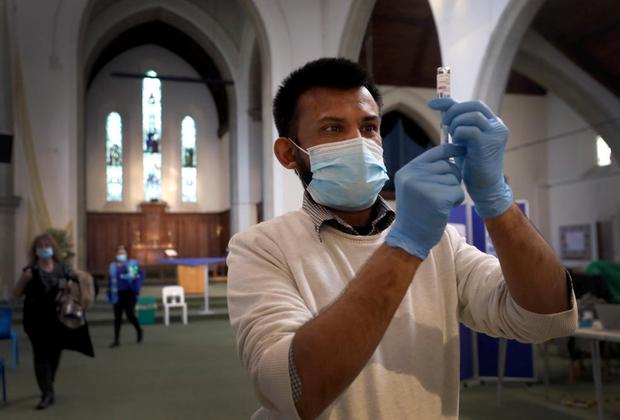
Pharmacist Rajan Shah prepares a syringe of the AstraZeneca vaccine at St John’s Church, in Ealing, London, Tuesday, March 16, 2021. In recent days, countries including Denmark, Ireland and Thailand have temporarily suspended their use of AstraZeneca’s coronavirus vaccine after reports that some people who got a dose developed blood clots, even though there’s no evidence that the shot was responsible. The European Medicines Agency and the World Health Organization say the data available do not suggest the vaccine caused the clots. Britain and several other countries have stuck with the vaccine. March 16, 2021
It has created a jagged divide across the globe, forcing politicians to assess the health risks of halting the shots at a time when many countries, especially in Europe, are already struggling to overcome logistical hurdles and vaccine hesitancy among their populations.
Sweden was the latest to join a swelling group of European Union nations choosing caution over speed, even as the head of the European Medicines Agency said the agency is “firmly convinced” that the benefits of the AstraZeneca shot outweigh the risks.
Emer Cooke noted Tuesday that thousands of people across the EU develop thromboses every year for a variety of reasons and that there were no reports of increased blood clots in the clinical studies of the AstraZeneca vaccine. Still, experts would undertake a “very rigorous analysis” and make a recommendation Thursday, she said.
Europe has the luxury to be able to pick from several vaccine candidates — but the decision is still not an easy one on the continent, where the virus is again surging and where the vaccination campaign has repeatedly stumbled.
The choice may be even more fraught elsewhere because many countries are relying heavily on AstraZeneca, which is cheaper and easier to handle than some other shots. The vaccine has so far played a huge role in the global initiative to ensure vaccines get to poorer countries known as COVAX.
The difficulty of the decision was clear in Thailand, the first country outside Europe to temporarily suspend use of the AstraZeneca vaccine, only to recant on Tuesday — when its prime minister received a dose.
“There are people who have concerns,” Prayuth Chan-ocha said after getting the shot. “But we must believe doctors, believe in our medical professionals.” Many other countries in Asia have likewise shrugged off concerns, though Indonesia halted use of the shot this week, saying it would wait for a World Health Organization report on the issue.
In addition to the EMA, AstraZeneca and the WHO have said there is no evidence the vaccine carries an increased risk of blood clots. There have been 37 reports of blood clots among the more than 17 million people who have received the vaccine across the EU and Britain, the company said.
“This is much lower than would be expected to occur naturally in a general population of this size and is similar across other licensed COVID-19 vaccines,” the Anglo-Swedish drugmaker said. But the number of countries in the bloc that are sticking with the shot is falling after heavyweights like Germany, Italy, France and Spain all said they were suspending it.
That left Belgium — and a handful of others such as Poland, Romania and Greece — increasingly isolated in their insistence that halting the shots now would cause a lot more harm that the side effects so hotly debated now.
“When you know how the virus is making the rounds, it would be very imprudent to stop,” Belgian Health Minister Frank Vandenbroucke told VRT network early Tuesday. Experts have noted that such concerns are inevitable in mass vaccination campaigns — with so many people getting shots, some are bound to get sick even if the vaccine is not to blame. That would mean “we’d have to incessantly interrupt campaigns during the coming months,” Vandenbroucke said.
“We wanted to remain as scientific as possible in the mediatic-political turmoil that is currently agitating Europe,” Belgian virologist Yves Van Laethem said. In Spain, which announced it was suspending the vaccine on Monday, some medical experts had their doubt about the move. Amós García, president of the Spanish Vaccinology Association, said that countries were being overzealous in halting use of AstraZeneca.
And the decisions seemed to be having a snowball effect. “There’s a cross-border contagion effect,” Garcia said. “Anything triggers the principle of caution,” García told Spanish broadcaster TVE. “Once it begins it’s like a domino, it becomes very difficult for a country to keep delivering the vaccine,” if others stop, even if only out of precaution.
With the torrent of decisions casting doubt on the AstraZeneca vaccine despite assurances of experts, public opinion was tested once again to believe science over suspicion. Serbia’s Prime Minister Ana Brnabic says the Balkan country won’t stop the use of Astra-Zeneca vaccines and insisted that “unfortunately, some people are having second thoughts because of a negative campaign.”
So often in disarray during the vaccine drive, the 27-nation EU was once again out of lockstep, with the member states each taking their own decision, as the executive Commission called on all to heed EMA advice. When asked if EU Commission President Ursula von der Leyen would take the AstraZeneca vaccine, her spokesman Eric Mamer said “of course.”
Jordans reported from Berlin. AP reporters around the world contributed to this report.








SÍGUENOS


ARCHIVOS
- Noviembre 2026 (11)
- Octubre 2026 (10)
- Septiembre 2026 (19)
- Agosto 2026 (14)
- Julio 2026 (17)
- Junio 2026 (19)
- Mayo 2026 (34)
- Abril 2026 (18)
- Marzo 2026 (22)
- Febrero 2026 (15)
- Enero 2026 (18)
- Diciembre 2025 (20)
