
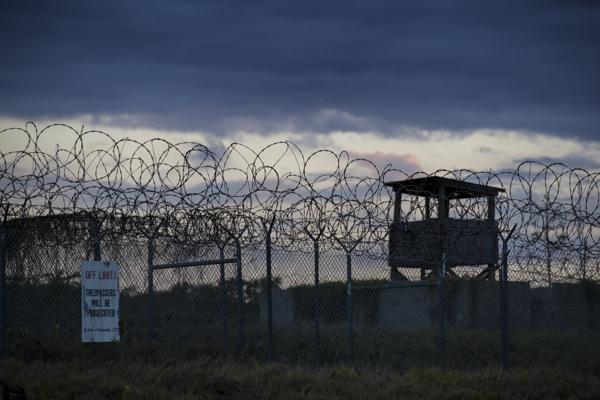
In this photo reviewed by U.S. military officials, the sun sets behind the closed Camp X-Ray detention facility, on April 17, 2019, in Guantanamo Bay Naval Base, Cuba. The Biden administration has been quietly laying the groundwork to release prisoners from the Guantanamo Bay detention center and at least move closer to being able to shut it down.
WASHINGTON (AP) — The Supreme Court sided with the government Thursday and dismissed a case involving a Guantanamo Bay detainee captured after the Sept. 11 attacks and tortured by the CIA abroad who has sought information about his treatment. The United States insisted that the information Abu Zubaydah sought must remain secret even though much has been widely reported.
Zubaydah, who was seized in Pakistan in 2002, was once thought to be a high-ranking member of the al-Qaida terrorist group that carried out the 2001 attacks. He was tortured while being held at so-called CIA black sites abroad before being transferred to Guantanamo in 2006.
Zubaydah was seeking to get the testimony of two former CIA contractors as part of an investigation into his treatment in Poland, where it has been widely reported he was once held. But six justices agreed his case should be thrown out.
Justice Stephen Breyer wrote for the majority that the government had argued “Zubaydah’s discovery request could force former CIA contractors to confirm the location of the detention site and that confirmation would itself significantly harm national security interests.
“In our view, the Government has provided sufficient support for its claim of harm to warrant application” of the so-called state secrets privilege, he said.
Many details about Zubaydah’s treatment have been reported, including that he was held in Thailand and Poland. The U.S. has allowed the disclosure of some information about his treatment. According to a 2014 Senate report, among other things Zubaydah was waterboarded more than 80 times and spent over 11 days in a coffin-size confinement box. Such techniques are now widely viewed as torture.
The U.S. has stopped short of acknowledging the locations of the black sites set up after 9/11 to gather intelligence about terrorist plots against Americans. The government has cited national security and its commitments to foreign partners.
Conservative Justice Neil Gorsuch, writing in a dissent for himself and liberal Justice Sonia Sotomayor, said Zubaydah’s detention in Poland is no secret. Nothing in the case “suggests that requiring the government to acknowledge what the world already knows to be true” would endanger national security, he wrote. “What was once a secret can, with the passage of time, become old news.”
Gorsuch noted that the events about which Zubaydah was seeking information had taken place two decades ago and have “long been declassified.”
“Official reports have been published, books written, and movies made about them. Still, the government seeks to have this suit dismissed on the ground it implicates a state secret — and today the Court acquiesces in that request. Ending this suit may shield the government from some further modest measure of embarrassment. But respectfully, we should not pretend it will safeguard any secret,” Gorsuch wrote.
Justice Elena Kagan agreed with the government that the former CIA contractors should be blocked from testifying about the location where Zubaydah was detained. But Kagan said a lower court could protect “classified information about location while giving Zubaydah access to unclassified information about detention conditions and interrogation methods.” She said she would have allowed that process to go forward and not have dismissed the case.
Zubaydah’s lawyer, Joseph Margulies, said in an email that he was studying the decision. Margulies had sought testimony from former CIA contractors James Mitchell and John “Bruce” Jessen, who are considered the architects of the CIA’s interrogation program. The two have testified before in other situations, including hearings at Guantanamo. Mitchell even wrote a book.
Still, the Biden administration, like the Trump administration before it, opposed Zubaydah getting their testimony.
A federal court initially ruled that Mitchell and Jessen shouldn’t be required to provide any information. But an appeals court ruled 2-1 that the lower court made a mistake in ruling out questioning entirely before attempting to separate what can and cannot be disclosed. The Supreme Court reversed that ruling and said the case should be dismissed.
Still, Zubaydah may have gotten something out of the lawsuit. During arguments in the case in October, Gorsuch pressed a government lawyer as to why Zubaydah himself could not provide information to Polish officials about his own treatment.
The administration later said in a letter to the court that it would allow Zubaydah to send a declaration that could be given to Polish officials. Breyer wrote that ability might further diminish his need for information about his treatment.
Gorsuch, however, said that “offer seems little more than an offer to let Zubaydah say whatever the government chooses to allow him to say.” He noted that the government said it would reserve the right to subject whatever Zubaydah produces to a “security review.”
In addition, “No one seems confident that Zubaydah remains mentally competent to testify about his treatment decades ago,” Gorsuch wrote. Zubydah’s lawyers had said in responding to the government that they would need to meet with him to determine “whether and to what extent, after years of torture and solitary confinement, he can still reliably reconstruct” the details of his treatment.
Español:
El alto tribunal se pone del lado del gobierno en el caso de secretos de estado de Gitmo, Base Naval de la Bahía de Guantánamo, Cuba.
En esta foto revisada por oficiales militares estadounidenses, el sol se pone detrás del centro de detención cerrado Camp X-Ray, el 17 de abril de 2019, en la Base Naval de la Bahía de Guantánamo, Cuba. La administración Biden ha estado sentando silenciosamente las bases para liberar a los prisioneros del centro de detención de la Bahía de Guantánamo y al menos acercarse a poder cerrarlo.
WASHINGTON (AP) — La Corte Suprema se puso del lado del gobierno el jueves y desestimó un caso que involucraba a un detenido de la Bahía de Guantánamo capturado después de los ataques del 11 de septiembre y torturado por la CIA en el extranjero que ha buscado información sobre su tratamiento. Los Estados Unidos insistieron en que la información que Abu Zubaydah buscaba debía permanecer en secreto a pesar de que se ha informado ampliamente de mucho.
Zubaydah, quien fue capturado en Pakistán en 2002, una vez se pensó que era un miembro de alto rango del grupo terrorista al-Qaida que llevó a cabo los ataques de 2001. Fue torturado mientras estaba detenido en los llamados sitios negros de la CIA en el extranjero antes de ser trasladado a Guantánamo en 2006.
Zubaydah estaba tratando de obtener el testimonio de dos ex contratistas de la CIA como parte de una investigación sobre su tratamiento en Polonia, donde se ha informado ampliamente que una vez estuvo detenido. Pero seis jueces acordaron que su caso debería ser desechado.
El juez Stephen Breyer escribió para la mayoría que el gobierno había argumentado que “la solicitud de descubrimiento de Zubaydah podría obligar a los ex contratistas de la CIA a confirmar la ubicación del sitio de detención y que la confirmación en sí misma dañaría significativamente los intereses de seguridad nacional.
“En nuestra opinión, el Gobierno ha proporcionado suficiente apoyo para que su reclamo de daño justifique la aplicación” del llamado privilegio de secretos de Estado, dijo.
Se han reportado muchos detalles sobre el tratamiento de Zubaydah, incluido que fue detenido en Tailandia y Polonia. Estados Unidos ha permitido la divulgación de cierta información sobre su tratamiento. Según un informe del Senado de 2014, entre otras cosas, Zubaydah fue sometido a submarino más de 80 veces y pasó más de 11 días en una caja de confinamiento del tamaño de un ataúd. Tales técnicas son ahora ampliamente vistas como tortura.
Estados Unidos no ha llegado a reconocer las ubicaciones de los sitios negros establecidos después del 9/11 para recopilar inteligencia sobre complots terroristas contra estadounidenses. El gobierno ha citado la seguridad nacional y sus compromisos con socios extranjeros.
El juez conservador Neil Gorsuch, escribiendo en disidencia para él y la jueza liberal Sonia Sotomayor, dijo que la detención de Zubaydah en Polonia no es ningún secreto. Nada en el caso “sugiere que exigir al gobierno que reconozca lo que el mundo ya sabe que es verdad” pondría en peligro la seguridad nacional, escribió. “Lo que una vez fue un secreto puede, con el paso del tiempo, convertirse en viejas noticias”.
Gorsuch señaló que los eventos sobre los cuales Zubaydah estaba buscando información habían tenido lugar hace dos décadas y han sido “desclasificados durante mucho tiempo”.
“Se han publicado informes oficiales, se han escrito libros y se han hecho películas sobre ellos. Aún así, el gobierno busca que se desestime esta demanda sobre la base de que implica un secreto de Estado, y hoy la Corte acepta esa solicitud. Poner fin a esta demanda puede proteger al gobierno de alguna medida modesta de vergüenza. Pero respetuosamente, no debemos pretender que salvaguardará ningún secreto”, escribió Gorsuch.
La jueza Elena Kagan estuvo de acuerdo con el gobierno en que se debería impedir que los ex contratistas de la CIA testifiquen sobre el lugar donde Zubaydah fue detenido. Pero Kagan dijo que un tribunal inferior podría proteger “información clasificada sobre la ubicación al tiempo que le da a Zubaydah acceso a información no clasificada sobre las condiciones de detención y los métodos de interrogatorio”. Dijo que habría permitido que ese proceso siguiera adelante y no habría desestimado el caso.
El abogado de Zubaydah, Joseph Margulies, dijo en un correo electrónico que estaba estudiando la decisión. Margulies había buscado el testimonio de los ex contratistas de la CIA James Mitchell y John “Bruce” Jessen, quienes son considerados los arquitectos del programa de interrogatorios de la CIA. Los dos han testificado antes en otras situaciones, incluidas las audiencias en Guantánamo. Mitchell incluso escribió un libro.
Aún así, la administración Biden, al igual que la administración Trump antes, se opuso a que Zubaydah obtuviera su testimonio.
Un tribunal federal dictaminó inicialmente que Mitchell y Jessen no deberían estar obligados a proporcionar ninguna información. Pero un tribunal de apelaciones dictaminó 2-1 que el tribunal inferior cometió un error al descartar el interrogatorio por completo antes de intentar separar lo que puede y no se puede revelar. La Corte Suprema revocó ese fallo y dijo que el caso debía ser desestimado.
Aún así, Zubaydah puede haber sacado algo de la demanda. Durante los argumentos en el caso en octubre, Gorsuch presionó a un abogado del gobierno sobre por qué el propio Zubaydah no podía proporcionar información a los funcionarios polacos sobre su propio trato.
La administración dijo más tarde en una carta al tribunal que permitiría a Zubaydah enviar una declaración que podría darse a los funcionarios polacos. Breyer escribió que esa habilidad podría disminuir aún más su necesidad de información sobre su tratamiento.
Gorsuch, sin embargo, dijo que “la oferta parece poco más que una oferta para dejar que Zubaydah diga lo que el gobierno decida permitirle decir”. Señaló que el gobierno dijo que se reservaría el derecho de someter lo que Zubaydah produzca a una “revisión de seguridad”.
Además, “nadie parece confiar en que Zubaydah siga siendo mentalmente competente para testificar sobre su tratamiento hace décadas”, escribió Gorsuch. Los abogados de Zubydah habían dicho al responder al gobierno que tendrían que reunirse con él para determinar “si y en qué medida, después de años de tortura y confinamiento solitario, todavía puede reconstruir de manera confiable” los detalles de su tratamiento.









SÍGUENOS


ARCHIVOS
- Abril 2026 (1)
- Marzo 2026 (22)
- Febrero 2026 (15)
- Enero 2026 (18)
- Diciembre 2025 (20)
- Noviembre 2025 (21)
- Octubre 2025 (20)
- Septiembre 2025 (10)
- Agosto 2025 (24)
- Julio 2025 (19)
- Junio 2025 (17)
- Mayo 2025 (12)
