

Ukrainian President Volodymyr Zelensky, center, Turkish President Recep Tayyip Erdogan, left, and United Nations Secretary General Antonio Guterres shake hands after their meeting in Lviv, Ukraine, Thursday, Aug. 18, 2022. (AP Photo/Evgeniy Maloletka)
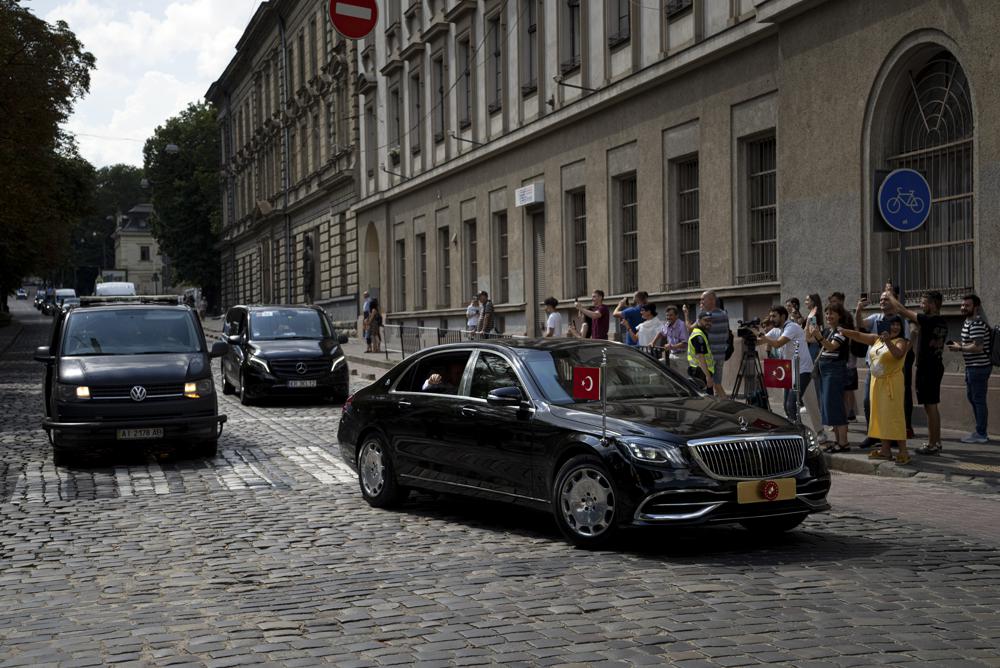
LVIV, Ukraine (AP) — Turkey’s leader and the U.N. chief met in Ukraine with President Volodymr Zelenskyy on Thursday in a high-powered bid to ratchet down a war raging for nearly six months. But little immediate progress was reported.
Turkish President Recep Tayyip Erdogan said he would follow up with Russian President Vladimir Putin, given that most of the matters discussed would require the Kremlin’s agreement.
With the meetings held at such a high level — it was the first visit to Ukraine by Erdogan since the war began, and the second by U.N. Secretary-General António Guterres — some had hoped for breakthroughs, if not toward an overall peace, then at least on specific issues. But none was apparent.
Meeting in the western city of Lviv, far from the front lines, the leaders discussed expanding exchanges of prisoners of war and arranging for U.N. atomic energy experts to visit and help secure Europe’s biggest nuclear power plant, which is in the middle of fierce fighting that has raised fears of catastrophe.
Erdogan has positioned himself as a go-between in efforts to stop the fighting. While Turkey is a member of NATO, its wobbly economy is reliant on Russia for trade, and it has tried to steer a middle course between the two combatants.
The Turkish president urged the international community after the talks not to abandon diplomatic efforts to end the war that has killed tens of thousands and forced more than 10 million Ukrainians from their homes.
He repeated that Turkey is willing to act as “mediator and facilitator” and added, “I remain convinced that the war will end at the negotiating table.”
In March, Turkey hosted talks in Istanbul between Russian and Ukrainian negotiators that failed to end the hostilities.
On the battlefield, meanwhile, at least 17 people were killed overnight in heavy Russian missile strikes on Ukraine’s Kharkiv region, Ukrainian authorities said Thursday.
Russia’s military claimed that it struck a base for foreign mercenaries in Kharkiv, killing 90. There was no immediate comment from the Ukrainian side.
In the latest incident on Russian soil near the border with Ukraine, an ammunition dump caught fire in a village in the Belgorod region, the regional governor said. No casualties were reported. Video posted online, whose authenticity couldn’t be verified, showed orange flames and black smoke, with the sound of multiple explosions.
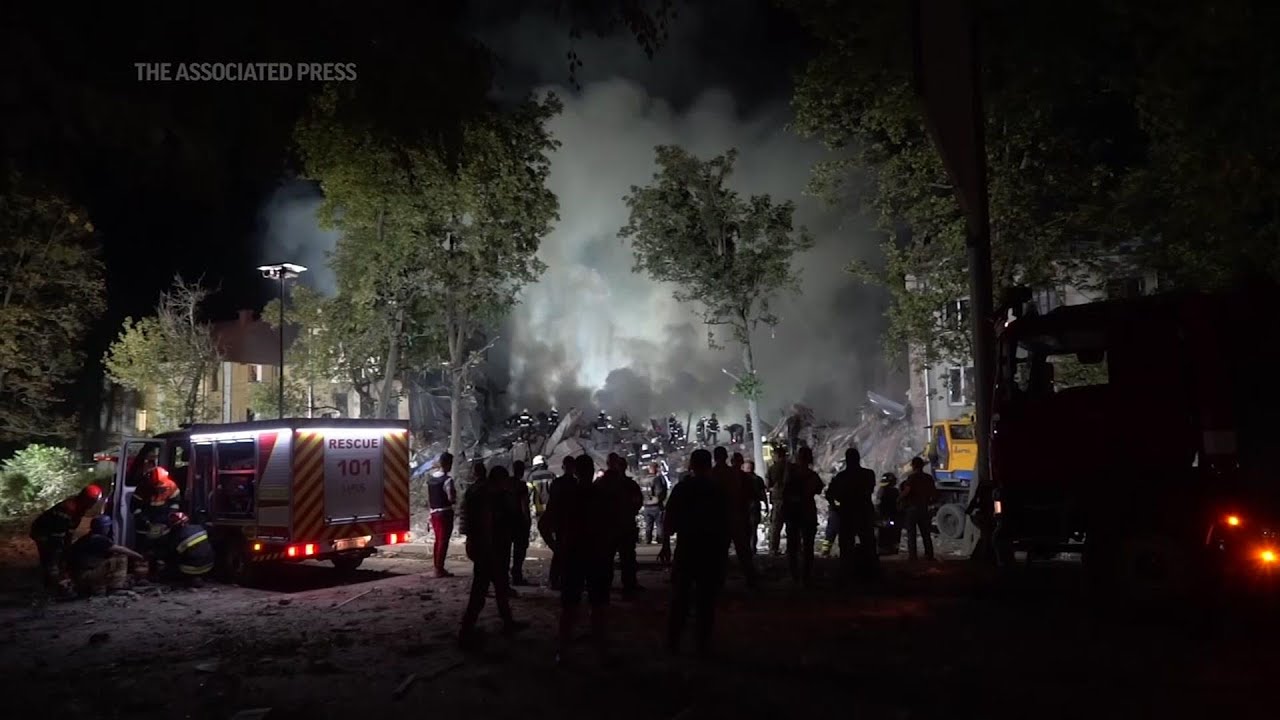
Elsewhere, Russian officials reported that anti-aircraft defenses shot down drones in the Russian-occupied Crimean Peninsula at Kerch and near the Belbek airfield in the Black Sea port of Sevastopol. Explosions in recent weeks on the peninsula have destroyed warplanes and caused other damage at military airfields.
Heightening international tensions, Russia deployed warplanes carrying state-of-the-art hypersonic missiles to its Kaliningrad region, an enclave surrounded by NATO members Lithuania and Poland.
One major topic at the talks in Lviv was the Zaporizhzhia nuclear plant in southern Ukraine. Moscow and Kyiv have accused each other of shelling the complex.
Condemning the Kremlin for what he called “nuclear blackmail,” Zelenskyy demanded that Russian troops leave the plant and that a team from the U.N.’s International Atomic Energy Agency be allowed in.
“The area needs to be demilitarized, and we must tell it as it is: Any potential damage in Zaporizhzhia is suicide,” Guterres said at a news conference.
Erdogan likewise expressed concern over the fighting around the plant, saying, “We don’t want to experience another Chernobyl” — a reference to the world’s worst nuclear accident, in Ukraine in 1986.
Zelenskyy and the U.N. chief agreed Thursday on arrangements for an IAEA mission to the plant, according to the president’s website. But it was not immediately clear whether the Kremlin would consent to the terms. As for a pullout of troops, a Russian Foreign Ministry official said earlier that that would leave the plant “vulnerable.”
Fears mounted Thursday when Russian and Ukrainian authorities accused each other of plotting to attack the site and then blame the other side. Late Thursday, multiple rounds of Ukrainian shelling struck the city in which the power plant is local, a Russian official reported.
Guterres used the talks in Lviv to name Gen. Carlos dos Santos Cruz of Brazil to lead a previously announced U.N. fact-finding mission to the Olenivka prison where 53 Ukrainian POWs were killed in an explosion in July. Russia and Ukraine have blamed each other for the blast.
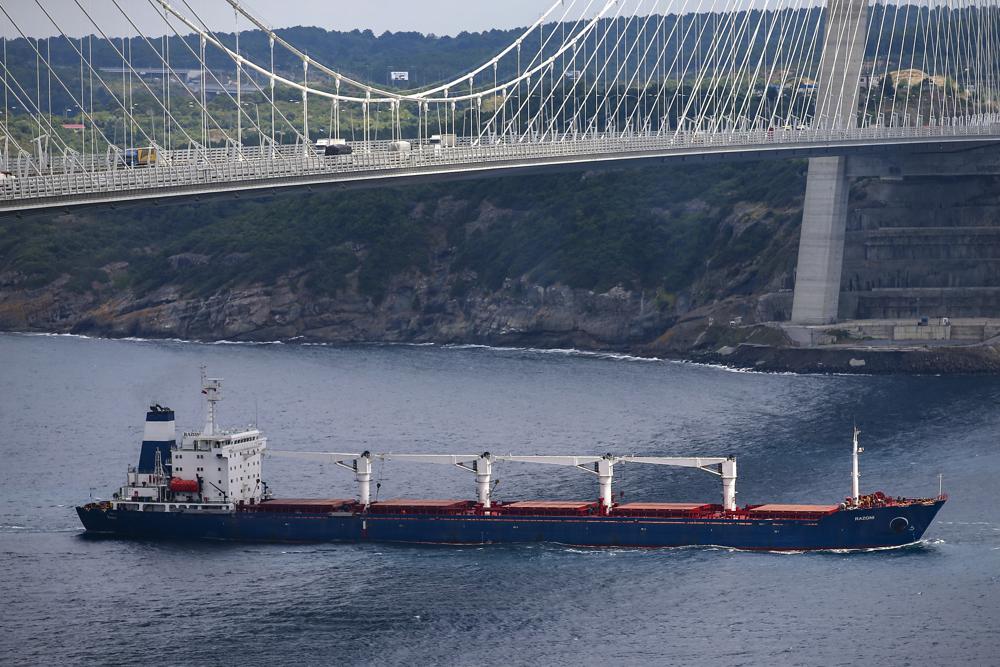
Also on the agenda Thursday: an increase in grain exports. Earlier this summer, the U.N. and Turkey brokered an agreement clearing the way for Ukraine to export 22 million tons of corn and other grain stuck in its Black Sea ports since the Russian invasion.
The blockage has worsened world food shortages, driven up prices and heightened fears of famine, especially in Africa. Yet even with the deal, only a trickle of Ukrainian grain has made it out — some 600,000 tons by Turkey’s estimate.
Zelenskyy said Thursday that he proposed expanding the shipments. Guterres, for his part, touted the operation’s success but added, “There is a long way to go before this will be translated into the daily life of people at their local bakery and in their markets.”
ESPAÑOL:
Las conversaciones de alto nivel en Ucrania arrojan pocos avances reportados.
El presidente ucraniano Volodymyr Zelensky, al centro, el presidente turco Recep Tayyip Erdogan, a la izquierda, y el secretario general de las Naciones Unidas, Antonio Guterres, se dan la mano después de su reunión en Lviv, Ucrania, el jueves 18 de agosto de 2022. (AP Foto/Evgeniy Maloletka)
LVIV, Ucrania (AP) — El líder de Turquía y el jefe de la ONU se reunieron el jueves en Ucrania con el presidente Volodymr Zelenskyy en un intento de alto poder por poner fin a una guerra que se libra desde hace casi seis meses. Pero se informó de pocos avances inmediatos.
El presidente turco, Recep Tayyip Erdogan, dijo que haría un seguimiento con el presidente ruso, Vladimir Putin, dado que la mayoría de los asuntos discutidos requerirían el acuerdo del Kremlin.
Con las reuniones celebradas a un nivel tan alto -fue la primera visita a Ucrania de Erdogan desde que comenzó la guerra, y la segunda del secretario general de la ONU, António Guterres-, algunos esperaban avances, si no hacia una paz general, al menos en temas específicos. Pero ninguno era aparente.
Reunidos en la ciudad occidental de Lviv, lejos de las líneas del frente, los líderes discutieron la expansión de los intercambios de prisioneros de guerra y los arreglos para que los expertos en energía atómica de la ONU visiten y ayuden a asegurar la planta de energía nuclear más grande de Europa, que se encuentra en medio de feroces combates que han aumentado los temores de catástrofe.
Erdogan se ha posicionado como un intermediario en los esfuerzos por detener los combates. Si bien Turquía es miembro de la OTAN, su tambaleante economía depende de Rusia para el comercio, y ha tratado de dirigir un curso medio entre los dos combatientes.
El presidente turco instó a la comunidad internacional después de las conversaciones a no abandonar los esfuerzos diplomáticos para poner fin a la guerra que ha matado a decenas de miles y obligado a más de 10 millones de ucranianos a abandonar sus hogares.
Repitió que Turquía está dispuesta a actuar como “mediador y facilitador” y agregó: “Sigo convencido de que la guerra terminará en la mesa de negociaciones”.
En marzo, Turquía organizó conversaciones en Estambul entre negociadores rusos y ucranianos que no lograron poner fin a las hostilidades.
Mientras tanto, en el campo de batalla, al menos 17 personas murieron durante la noche en fuertes ataques con misiles rusos en la región ucraniana de Járkov, dijeron el jueves las autoridades ucranianas.
El ejército de Rusia afirmó que atacó una base para mercenarios extranjeros en Kharkiv, matando a 90. No hubo comentarios inmediatos de la parte ucraniana.
En el último incidente en suelo ruso cerca de la frontera con Ucrania, un vertedero de municiones se incendió en una aldea en la región de Belgorod, dijo el gobernador regional. No se reportaron víctimas. El video publicado en línea, cuya autenticidad no pudo ser verificada, mostró llamas naranjas y humo negro, con el sonido de múltiples explosiones.
Elsewhere, Russian officials reported that anti-aircraft defenses shot down drones in the Russian-occupied Crimean Peninsula at Kerch and near the Belbek airfield in the Black Sea port of Sevastopol. Explosions in recent weeks on the peninsula have destroyed warplanes and caused other damage at military airfields.
Heightening international tensions, Russia deployed warplanes carrying state-of-the-art hypersonic missiles to its Kaliningrad region, an enclave surrounded by NATO members Lithuania and Poland.
One major topic at the talks in Lviv was the Zaporizhzhia nuclear plant in southern Ukraine. Moscow and Kyiv have accused each other of shelling the complex.
Condemning the Kremlin for what he called “nuclear blackmail,” Zelenskyy demanded that Russian troops leave the plant and that a team from the U.N.’s International Atomic Energy Agency be allowed in.
“The area needs to be demilitarized, and we must tell it as it is: Any potential damage in Zaporizhzhia is suicide,” Guterres said at a news conference.
Erdogan likewise expressed concern over the fighting around the plant, saying, “We don’t want to experience another Chernobyl” — a reference to the world’s worst nuclear accident, in Ukraine in 1986.
Zelenskyy and the U.N. chief agreed Thursday on arrangements for an IAEA mission to the plant, according to the president’s website. But it was not immediately clear whether the Kremlin would consent to the terms. As for a pullout of troops, a Russian Foreign Ministry official said earlier that that would leave the plant “vulnerable.”
Fears mounted Thursday when Russian and Ukrainian authorities accused each other of plotting to attack the site and then blame the other side. Late Thursday, multiple rounds of Ukrainian shelling struck the city in which the power plant is local, a Russian official reported.
Guterres used the talks in Lviv to name Gen. Carlos dos Santos Cruz of Brazil to lead a previously announced U.N. fact-finding mission to the Olenivka prison where 53 Ukrainian POWs were killed in an explosion in July. Russia and Ukraine have blamed each other for the blast.
También en la agenda del jueves: un aumento en las exportaciones de granos. A principios de este verano, la ONU y Turquía negociaron un acuerdo que despeja el camino para que Ucrania exporte 22 millones de toneladas de maíz y otros granos atrapados en sus puertos del Mar Negro desde la invasión rusa.
El bloqueo ha empeorado la escasez mundial de alimentos, ha elevado los precios y ha aumentado los temores de hambruna, especialmente en África. Sin embargo, incluso con el acuerdo, solo un goteo de grano ucraniano ha salido, unas 600.000 toneladas según la estimación de Turquía.
Zelenskyy dijo el jueves que propuso expandir los envíos. Guterres, por su parte, promocionó el éxito de la operación, pero agregó: “Hay un largo camino por recorrer antes de que esto se traduzca en la vida cotidiana de las personas en su panadería local y en sus mercados”.









SÍGUENOS


ARCHIVOS
- Marzo 2026 (22)
- Febrero 2026 (15)
- Enero 2026 (18)
- Diciembre 2025 (20)
- Noviembre 2025 (21)
- Octubre 2025 (20)
- Septiembre 2025 (10)
- Agosto 2025 (24)
- Julio 2025 (19)
- Junio 2025 (17)
- Mayo 2025 (12)
- Abril 2025 (11)
