
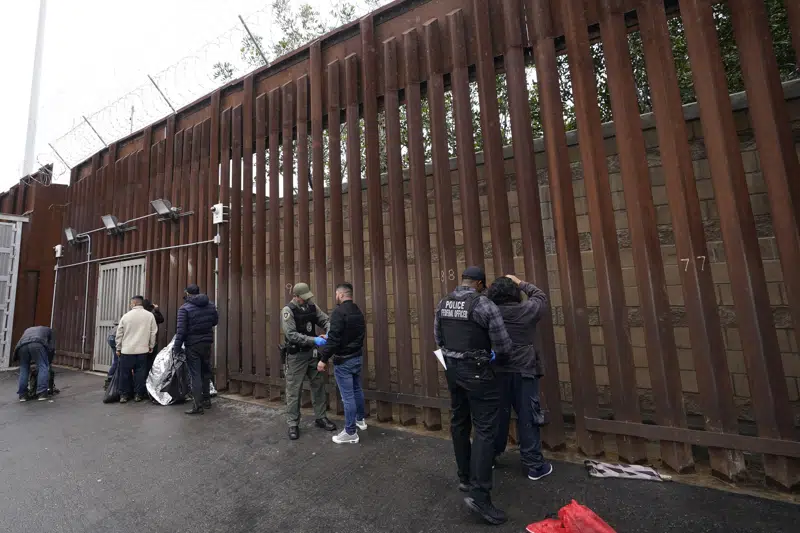
Federal officers remove handcuffs from men before releasing them through a gate in a border wall to Tijuana, Mexico, Wednesday, March 15, 2023, in San Diego. Some asylum-seekers who crossed the border from Mexico are waiting 10 years just for a court date. The Border Patrol released people with notices to appear at a U.S. Immigration and Customs Enforcement office. The move saved the Border Patrol untold hours processing court papers, but it left the job to an agency that had no extra staff for the increased workload. (AP Photo/Gregory Bull)
SAN DIEGO (AP) — U.S. immigration offices have become so overwhelmed with processing migrants for court that some some asylum-seekers who crossed the border at Mexico may be waiting a decade before they even get a date to see a judge.
The backlog stems from a change made two months after President Joe Biden took office, when Border Patrol agents began now-defunct practice of quickly releasing immigrants on parole. They were given instructions to report to a U.S. Immigration and Customs Enforcement office at their final destination to be processed for court — work previously done by the Border Patrol.
The change prevented the kind of massive overcrowding of holding cells in 2019, when some migrants stood on toilets for room to breathe. But the cost became evident as ICE officers tasked with issuing court papers couldn’t keep pace.
Offices in some cities are now telling migrants to come back years from now, and the extra work has strained ICE’s capacity for its traditional work of enforcing immigration laws in the U.S. interior.
“We’re being stretched to the limit,” said Jamison Matuszewski, director of enforcement and removal operations in San Diego.
As for migrants, waits to get a court date vary. In New York, ICE told asylum-seekers this month to return in March 2033, U.S. Rep. Henry Cuellar, a Texas Democrat, said at a recent hearing. In nine other cities — San Antonio; Miramar, Florida; Los Angeles; Jacksonville, Florida; Milwaukee; Chicago; Washington; Denver; and Mount Laurel, New Jersey — the wait is until March 2027.
Until then, the migrants in question won’t even get an initial court appearance on the books, though they can live and work in the U.S. After that, their case will work its way through the U.S. immigrant courts — a process that takes about four years amid a backlog that reached 2.1 million cases in January, up from about 600,000 in 2017.
“The asylum system is in dire need of reform from top to bottom,” Homeland Security Secretary Alejandro Mayorkas told reporters last week when asked about the waits for a court notice.
Tae Johnson, ICE’s acting director, told lawmakers the agency wants to use online interviews to help cut the 10-year waits and that he wants congressional authority to issue court orders electronically. He also said more funding would go a long way toward “quickly eliminating” the backlog.









SÍGUENOS


ARCHIVOS
- Marzo 2026 (22)
- Febrero 2026 (15)
- Enero 2026 (18)
- Diciembre 2025 (20)
- Noviembre 2025 (21)
- Octubre 2025 (20)
- Septiembre 2025 (10)
- Agosto 2025 (24)
- Julio 2025 (19)
- Junio 2025 (17)
- Mayo 2025 (12)
- Abril 2025 (11)
