
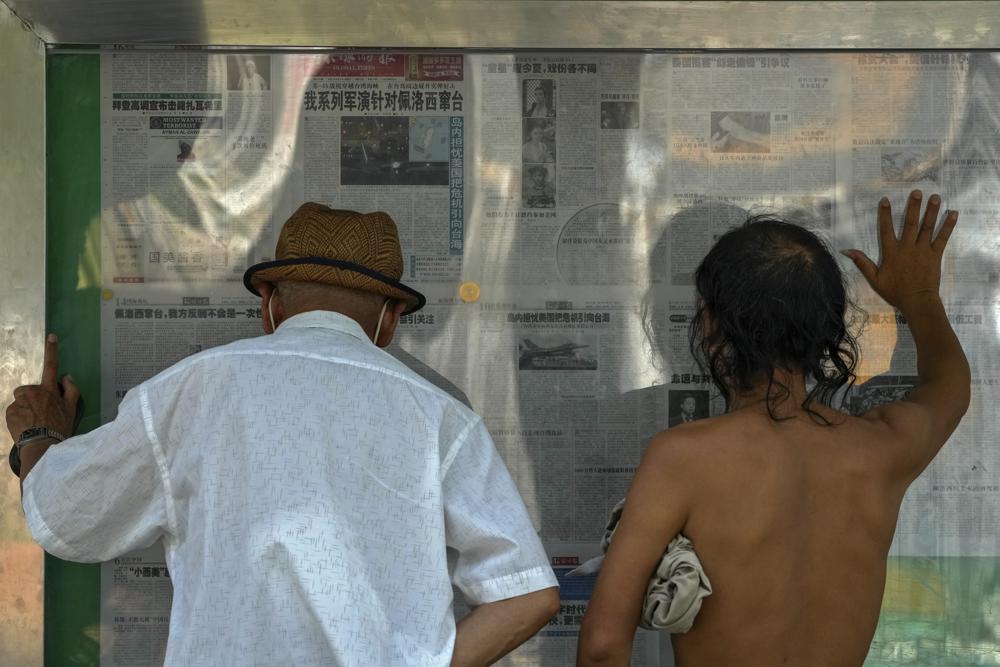
Residents read a newspaper with a photo of a plane carrying U.S. House Speaker Nancy Pelosi lands at Songshan Airport in Taipei, Taiwan with a headline reporting “Our series of military exercises are aimed at Pelosi channeling Taiwan” at a stand in Beijing, Wednesday, Aug. 3, 2022. After weeks of threatening rhetoric, China stopped short of any direct military confrontation with the U.S. over the visit of Pelosi to Taiwan. The response disappointed some Chinese, who asked why no action was taken to stop her. (AP Photo/Andy Wong)
BEIJING (AP) — A few Chinese old-timers read the pages of a newspaper on Wednesday hung up behind glass on an outdoor display board in a relic of pre-smartphone days, when that’s how people in China got the news.
Wang Junzhong, 70, peered at an editorial in the Global Times, an outspoken, fiercely nationalistic voice of the ruling Communist Party. The headline read, “To safeguard national sovereignty and security, the Chinese military dares to show the spirit of the sword.”
After weeks of threatening rhetoric, China showed the spirit but stopped short of any direct military confrontation with the U.S. over the visit to Taiwan of a senior American politician, House Speaker Nancy Pelosi.
Instead, it opted for military drills as a show of force, sending fighter jets into the air and scrambling crews on navy ships in simulated emergencies after Pelosi defied Chinese warnings and flew into Taiwan on a U.S. government plane on Tuesday night.
The failure to stop Pelosi from visiting Taiwan — a self-governing island that China claims as its territory — disappointed some Chinese who had been riled up by the government’s tough words ahead of her trip. But Wang, in long sleeves and long pants despite the muggy weather, expressed understanding.
“If China didn’t care about its people, it could just go ahead and use force,” Wang said. “If China cares about its people, it’s fine to tolerate for now. There is not much we can do. I think the leaders are facing a dilemma.”
Bringing Taiwan, an island of 23 million people just 160 kilometers (100 miles) off China’s east coast, under Chinese control is a longstanding goal of the Communist Party. Its leaders say that Taiwan is part of China and that the U.S. and other countries have no right to meddle in what it considers a domestic issue.
The U.S., under a one-China policy, doesn’t recognize Taiwan as a nation but maintains informal relations and defense ties with its government — to China’s displeasure. But China is loath to get into a war with the United States, even as it adds aircraft carriers and high-tech weaponry to its forces.
“This is for sure because China and the U.S. need each other in trade and other aspects,” said Song Ao, a 21-year-old university student. “I think we must exert pressure in response to Pelosi’s Taiwan visit, but not fight.”
The Chinese military drills concerned both officials and some residents in Taipei, the Taiwanese capital. China said it had launched live-fire exercises on Tuesday night and announced drills starting Thursday in six offshore areas that a Taiwanese military official described as “sealing off Taiwan by air and sea.”
The drills may be routine but they are too close to Taiwan, said David Hong, a retired Taiwanese American financial consultant who was outside the legislature on Wednesday to try to catch a glimpse of Pelosi.
“It shows their ambitions,” he said. “We need to stop them. No more invasion.”
Crowds waited for Pelosi’s arrival outside her hotel on Tuesday night, and some applauded as her motorcade, escorted by police cars with flashing lights, zipped by and entered an underground parking area.
Pan Kuan, a 30-year-old English teacher, said the U.S. House speaker showed courage by going ahead with her trip.
“Although there was a great pressure from China, she still chose the camp with democracy and freedom, and courageously came to Taiwan,” he said. “She is like a hero. She courageously fought China’s pressure. I think that takes some courage to do so.”
An almost equal-sized crowd of pro-Beijing protesters also gathered outside the Grand Hyatt hotel, cursing Pelosi and telling her to leave.
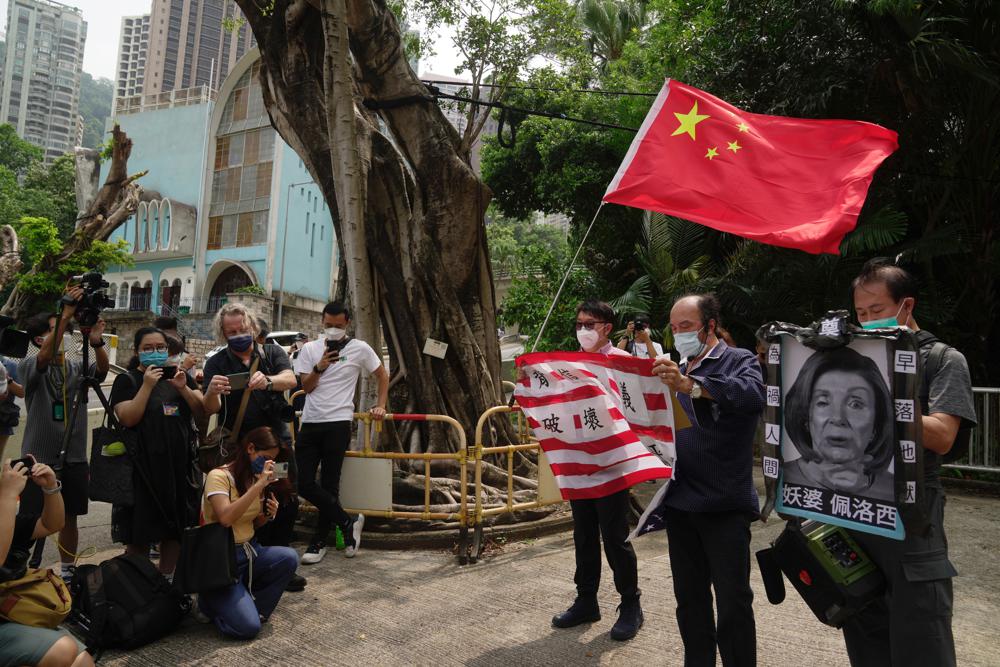
Supporters of Beijing also protested outside the U.S. Consulate in Hong Kong on Wednesday, holding up signs and ripping American flags in groups of four to abide by COVID-19 restrictions on public gatherings.
They shouted “Pelosi, get out of Taiwan,” “Destroying China-US relations” and other slogans and threw eggs at a photo of Pelosi.
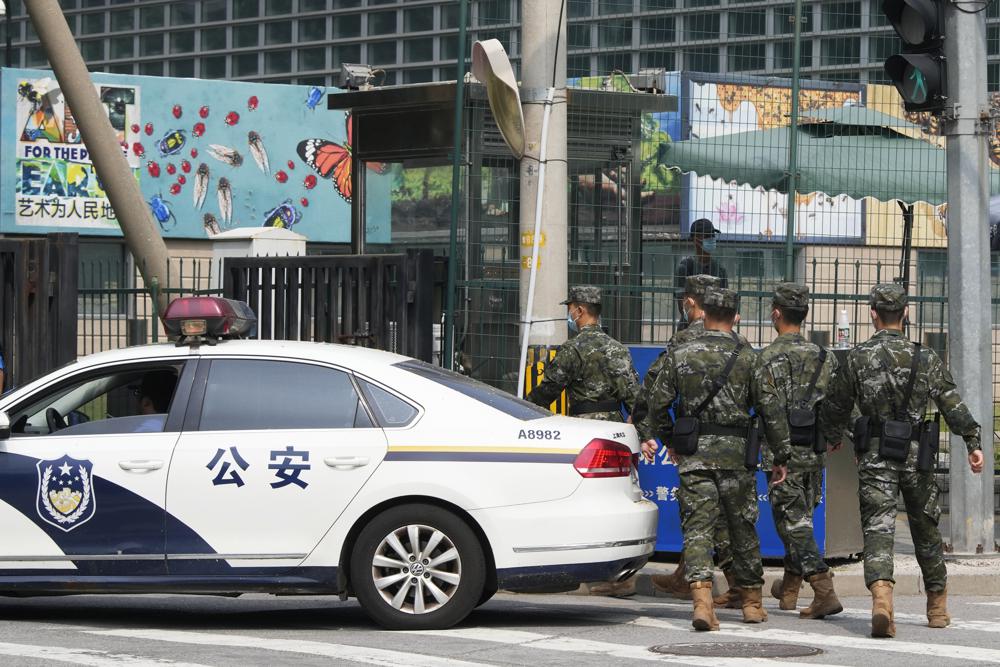
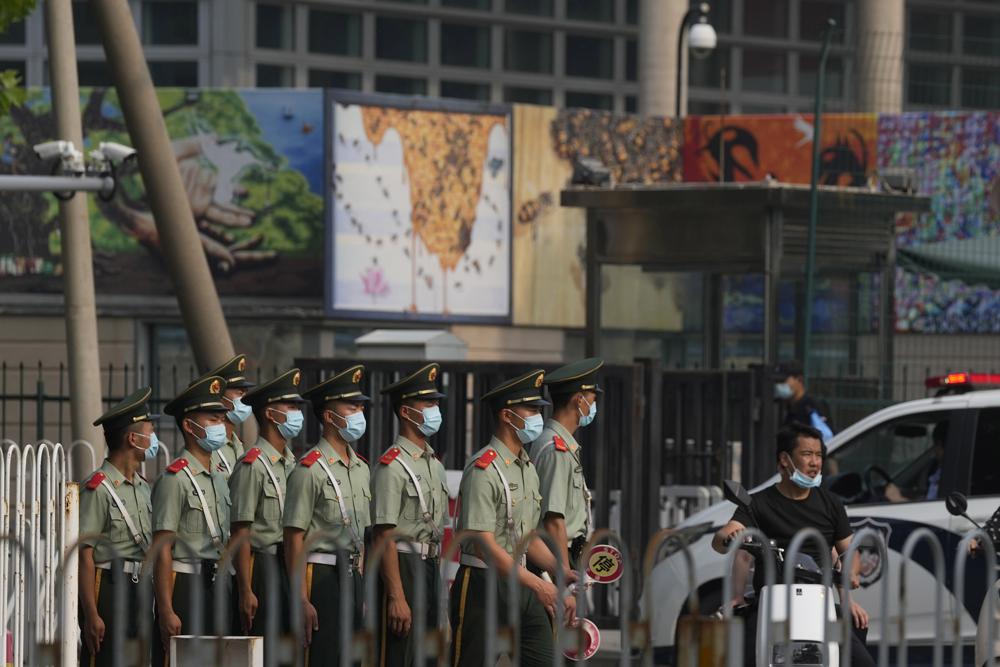
There were no public protests in Beijing, where both plainclothes and uniformed security personnel were posted around the U.S. Embassy and the Foreign Ministry.
After seeing Pelosi’s plane land, shown live by some Chinese digital news outlets, many in China rushed to the social media account of Foreign Ministry spokesperson Zhao Lijian — who had been issuing threats for days — to express disappointment that no strong action was taken to stop her. Others expressed support for the government’s approach.
“They shouldn’t have talked big in the beginning,” Wang said. “If they had played it down, people wouldn’t feel repulsed. Because they gave away too much, it became difficult to wind up. After all, we didn’t want to use force when she came to visit.”
ESPAÑOL:
La visita de Pelosi a Taiwán cautiva al público en China y Taiwán
Los residentes leyeron un periódico con una foto de un avión que transportaba a la presidenta de la Cámara de Representantes de los Estados Unidos, Nancy Pelosi, aterrizando en el aeropuerto Songshan en Taipei, Taiwán, con un titular que informaba “Nuestra serie de ejercicios militares están dirigidos a Pelosi canalizando Taiwán” en un puesto en Beijing, el miércoles 3 de agosto de 2022. Después de semanas de retórica amenazante, China no llegó a ninguna confrontación militar directa con Estados Unidos por la visita de Pelosi a Taiwán. La respuesta decepcionó a algunos chinos, que preguntaron por qué no se tomaron medidas para detenerla. (AP Foto/Andy Wong)
BEIJING (AP) — Algunos veteranos chinos leyeron el miércoles las páginas de un periódico colgado detrás de un vidrio en un tablero de exhibición al aire libre en una reliquia de los días anteriores a los teléfonos inteligentes, cuando así es como la gente en China recibió la noticia.
Wang Junzhong, de 70 años, miró un editorial en el Global Times, una voz abierta y ferozmente nacionalista del gobernante Partido Comunista. El titular decía: “Para salvaguardar la soberanía y la seguridad nacionales, el ejército chino se atreve a mostrar el espíritu de la espada”.
Después de semanas de retórica amenazante, China mostró el espíritu, pero no llegó a ninguna confrontación militar directa con Estados Unidos por la visita a Taiwán de un político estadounidense de alto rango, la presidenta de la Cámara de Representantes, Nancy Pelosi.
En cambio, optó por ejercicios militares como una demostración de fuerza, enviando aviones de combate al aire y revolviendo tripulaciones en barcos de la armada en emergencias simuladas después de que Pelosi desafió las advertencias chinas y voló a Taiwán en un avión del gobierno de Estados Unidos el martes por la noche.
El fracaso en impedir que Pelosi visitara Taiwán, una isla autónoma que China reclama como su territorio, decepcionó a algunos chinos que se habían enojado por las duras palabras del gobierno antes de su viaje. Pero Wang, en mangas largas y pantalones largos a pesar del clima bochornoso, expresó comprensión.
“Si China no se preocupara por su gente, podría seguir adelante y usar la fuerza”, dijo Wang. “Si China se preocupa por su gente, está bien tolerarlo por ahora. No hay mucho que podamos hacer. Creo que los líderes se enfrentan a un dilema”.
Poner Taiwán, una isla de 23 millones de personas a solo 160 kilómetros (100 millas) de la costa este de China, bajo control chino es un objetivo de larga data del Partido Comunista. Sus líderes dicen que Taiwán es parte de China y que Estados Unidos y otros países no tienen derecho a entrometerse en lo que considera un problema interno.
The U.S., under a one-China policy, doesn’t recognize Taiwan as a nation but maintains informal relations and defense ties with its government — to China’s displeasure. But China is loath to get into a war with the United States, even as it adds aircraft carriers and high-tech weaponry to its forces.
“This is for sure because China and the U.S. need each other in trade and other aspects,” said Song Ao, a 21-year-old university student. “I think we must exert pressure in response to Pelosi’s Taiwan visit, but not fight.”
The Chinese military drills concerned both officials and some residents in Taipei, the Taiwanese capital. China said it had launched live-fire exercises on Tuesday night and announced drills starting Thursday in six offshore areas that a Taiwanese military official described as “sealing off Taiwan by air and sea.”
The drills may be routine but they are too close to Taiwan, said David Hong, a retired Taiwanese American financial consultant who was outside the legislature on Wednesday to try to catch a glimpse of Pelosi.
“It shows their ambitions,” he said. “We need to stop them. No more invasion.”
Crowds waited for Pelosi’s arrival outside her hotel on Tuesday night, and some applauded as her motorcade, escorted by police cars with flashing lights, zipped by and entered an underground parking area.
Pan Kuan, a 30-year-old English teacher, said the U.S. House speaker showed courage by going ahead with her trip.
“Although there was a great pressure from China, she still chose the camp with democracy and freedom, and courageously came to Taiwan,” he said. “She is like a hero. She courageously fought China’s pressure. I think that takes some courage to do so.”
An almost equal-sized crowd of pro-Beijing protesters also gathered outside the Grand Hyatt hotel, cursing Pelosi and telling her to leave.
Los partidarios de Beijing también protestaron frente al Consulado de Estados Unidos en Hong Kong el miércoles, sosteniendo carteles y rasgando banderas estadounidenses en grupos de cuatro para cumplir con las restricciones de COVID-19 en las reuniones públicas.
Gritaron “Pelosi, sal de Taiwán”, “Destruyendo las relaciones entre China y Estados Unidos” y otros eslóganes y lanzaron huevos a una foto de Pelosi.
No hubo protestas públicas en Beijing, donde tanto los vestidos de civil como el personal de seguridad uniformado fueron colocados alrededor de la Embajada de los Estados Unidos y el Ministerio de Relaciones Exteriores.
Después de ver aterrizar el avión de Pelosi, mostrado en vivo por algunos medios de comunicación digitales chinos, muchos en China se apresuraron a la cuenta de redes sociales del portavoz del Ministerio de Relaciones Exteriores, Zhao Lijian, quien había estado emitiendo amenazas durante días, para expresar su decepción porque no se tomaron medidas enérgicas para detenerla. Otros expresaron su apoyo al enfoque del gobierno.
“No deberían haber hablado mucho al principio”, dijo Wang. “Si lo hubieran minimizado, la gente no se sentiría rechazada. Debido a que regalaron demasiado, se hizo difícil terminar. Después de todo, no queríamos usar la fuerza cuando ella vino de visita”.

___








SÍGUENOS


ARCHIVOS
- Marzo 2026 (22)
- Febrero 2026 (15)
- Enero 2026 (18)
- Diciembre 2025 (20)
- Noviembre 2025 (21)
- Octubre 2025 (20)
- Septiembre 2025 (10)
- Agosto 2025 (24)
- Julio 2025 (19)
- Junio 2025 (17)
- Mayo 2025 (12)
- Abril 2025 (11)
