

A Ukrainian soldier stands a top a destroyed Russian APC after recent battle in Kharkiv, Ukraine, on March 26, 2022. With Russia continuing to strike and encircle urban populations, from Chernihiv and Kharkiv in the north to Mariupol in the south, Ukrainian authorities said Saturday that they cannot trust statements from the Russian military Friday suggesting that the Kremlin planned to concentrate its remaining strength on wresting the entirety of Ukraine’s eastern Donbas region from Ukrainian control. (AP Photo/Efrem Lukatsky)
KYIV, Ukraine (AP) — With its aspirations for a quick victory dashed by a stiff Ukrainian resistance, Russia has increasingly focused on grinding down Ukraine’s military in the east in the hope of forcing Kyiv into surrendering part of the country’s territory to possibly end the war.
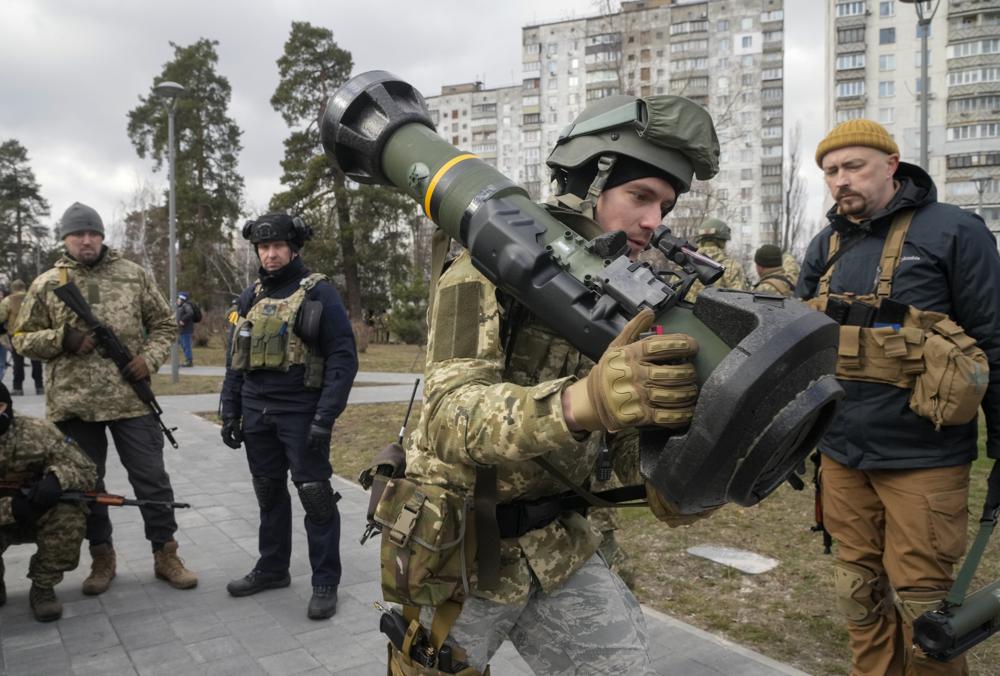
The bulk of the Ukrainian army is concentrated in eastern Ukraine, where it has been locked up in fighting with Moscow-backed separatists in a nearly eight-year conflict. If Russia succeeds in encircling and destroying the Ukrainian forces in the country’s industrial heartland called Donbas, it could try to dictate its terms to Kyiv and, possibly, attempt to split the country in two.
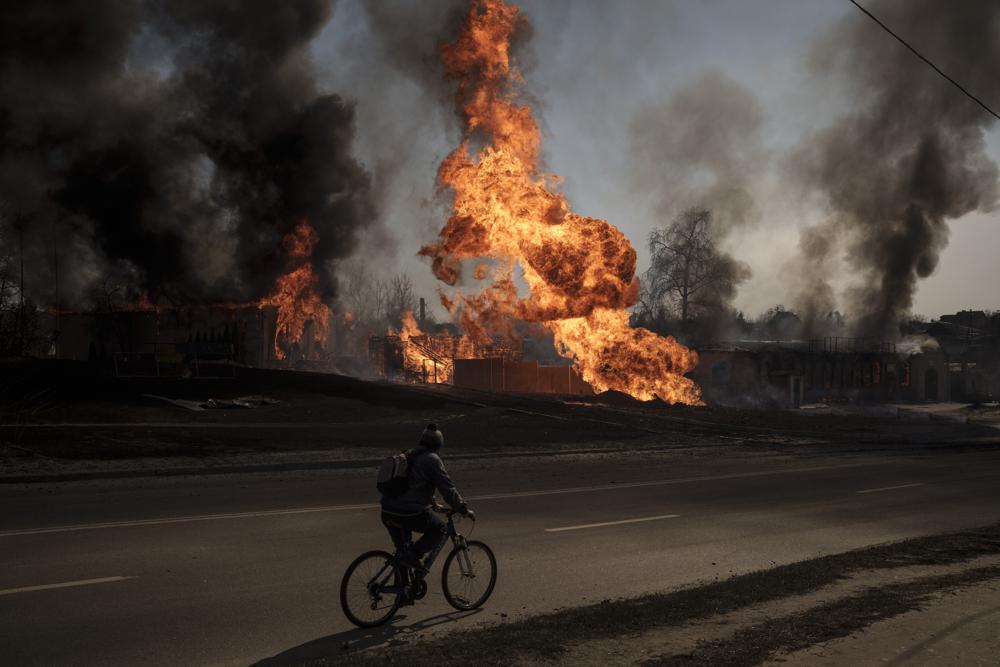
The Russian military declared Friday that the “first stage of the operation” had been largely accomplished, allowing Russian troops to concentrate on their “top goal — the liberation of Donbas.”
Many observers say the shift in strategy could reflect President Vladimir Putin’s acknowledgment that his plan for a blitz in Ukraine has failed, forcing him to narrow his goals and change tactics amid a disastrous war that has turned Russia into a pariah and decimated its economy.
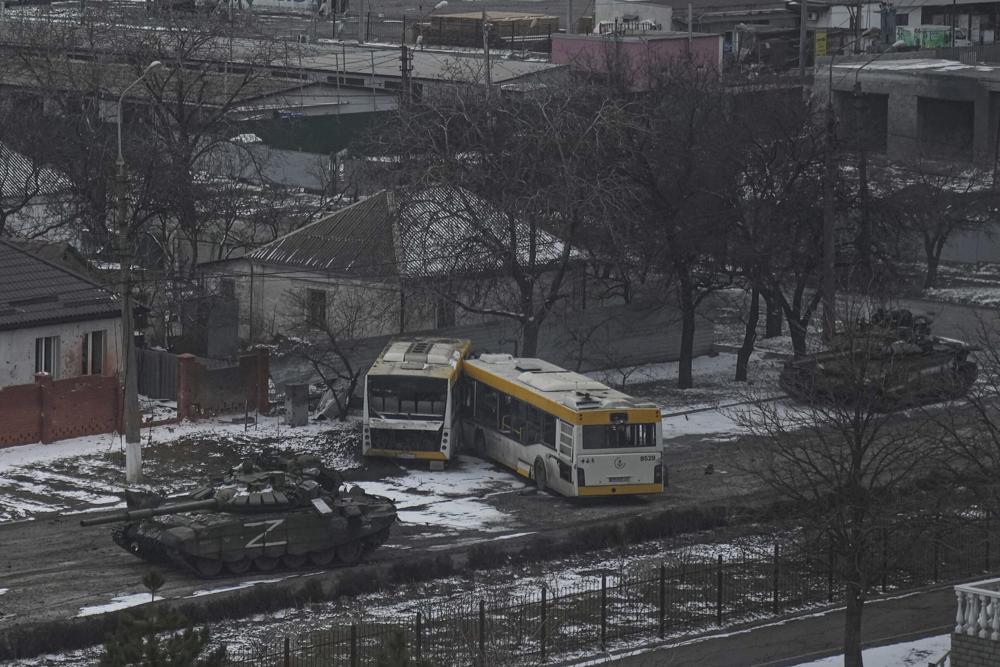
U.S. and British officials also have noted that Moscow has increasingly focused on fighting the Ukrainian forces in the east while digging in around Kyiv and other big cities and pummeling them with rockets and artillery.
The chief of Ukrainian military intelligence, Kyrylo Budanov, said Sunday the change of focus could reflect Putin’s hope to break Ukraine in two, like North and South Korea, and enforce “a line of separation between the occupied and unoccupied regions.”
“He can’t swallow the entire country,” Budanov said, adding that Russia appears to be trying “to pull the occupied territories into a single quasi-state structure and pit it against independent Ukraine.”
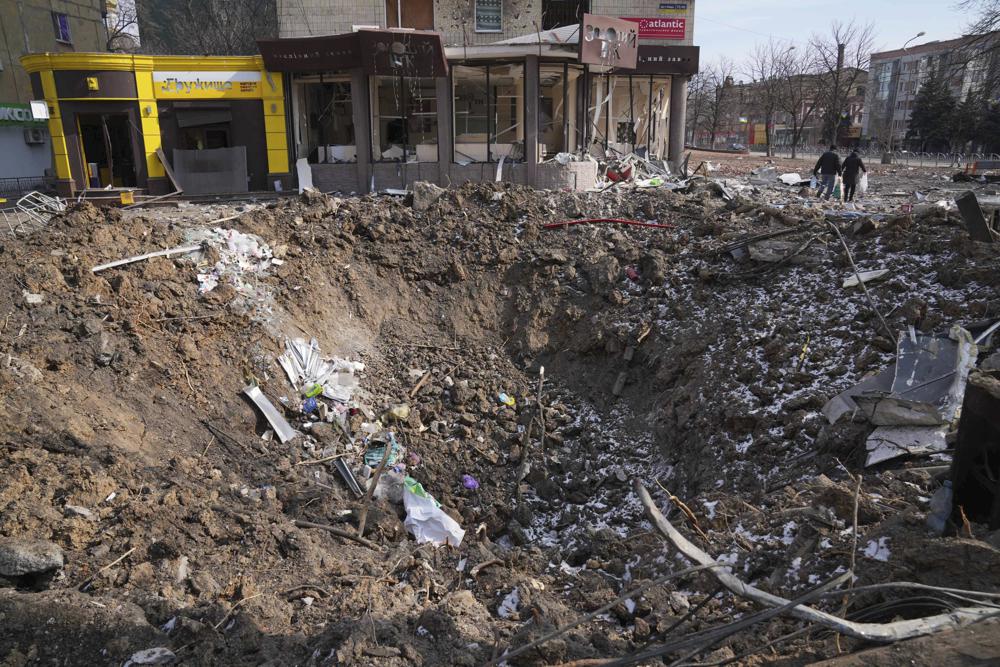
Putin and his generals haven’t revealed specific military goals or a planned timeline, but the Kremlin clearly expected a quick victory when Russian troops rolled into Ukraine from the north, east and south on Feb. 24.
But the Russian attempts to swiftly capture the Ukrainian capital of Kyiv, the country’s second-largest city, Kharkiv, and other big cities in the northeast have been thwarted by well-organized Ukrainian defenses and logistical challenges that stalled the Russian offensive.
Russian forces have pounded the outskirts of Kyiv with artillery and air raids from a distance while putting their ground offensive on hold, tactics they also have used in attacking Kharkiv, Chernihiv and Sumy in the northeast.
In some sectors, including the city of Makariv that sits near a strategic highway west of Kyiv, Ukrainian troops have pushed the Russians back.
Associated Press reporters saw the carcass of a Russian rocket launcher, a burned Russian truck, the body of a Russian soldier and a destroyed Ukrainian tank after the fighting there a few days ago. In the nearby village of Yasnohorodka, the AP witnessed positions abandoned by Ukrainian soldiers, who moved farther west, but no sign of Russian troops’ presence.
Mykola Sunhurovskyi, a military analyst at the Kyiv-based Razumkov Center think tank, said Russia has abandoned attempts to storm Kyiv and other big Ukrainian cities for now and is laying siege to them to try to weaken Ukraine and win time.
“Russia has shifted tactics … to redistribute its forces and prepare for the next active stage of the war,” Sunhurovskyi said.
The Russian forces encircled the key strategic port of Mariupol and besieged it for weeks, hammering it with rockets and artillery in a carnage that killed thousands of civilians. The fall of Mariupol would free up Russian forces there and allow them to engage in a potential pincer movement together with another group of troops moving from Kharkiv in the northeast to try to encircle the Ukrainian military in the east.
“Russian forces appear to be concentrating their effort to attempt the encirclement of Ukrainian forces directly facing the separatist regions in the east of the country, advancing from the direction of Kharkiv in the north and Mariupol in the south,” the British Ministry of Defense said Sunday.
A senior U.S. defense official also noted the latest Russian focus on Donbas. The official said Putin may now hope to take full control of the east while keeping other Ukrainian forces occupied with the defense of Kyiv and other areas and then try to pressure Ukrainian President Volodymyr Zelenskyy to formally surrender control over Donbas and recognize Russia’s ownership of Crimea, which Moscow annexed in 2014.
An analysis published Saturday by the Institute for the Study of War in Washington said the degree to which the Russians can push an accelerated move to cut off Donbas will depend in part on how soon their forces can gain full control of Mariupol and how badly damaged they emerge from that fight. It also noted that a halt in the Russian offensive on Kyiv could reflect “the incapacity of Russian forces rather than any shift in Russian objectives or efforts at this time.”
While the Russian military has focused increasingly on bleeding the Ukrainian troops in the east, it has continued to use its arsenal of air- and sea-launched cruise missiles to methodically target fuel depots, military arsenals and weapons plants across the country.
Philips P. Obrien, a professor of strategic studies at the University of St. Andrews, described Saturday’s cruise missile strikes on Lviv near the border with Poland as part of the Russian strategy to cut off supplies to the Ukrainian forces fighting in the east.
“They will still want to disrupt as much as possible the flow of goods and supplies from west to east, much of which starts their journey around Lviv,” Obrien observed.
On the Black Sea coast, the Russians quickly took the port of Kherson and advanced to the outskirts of the key shipbuilding center of Mykolaiv where their offensive stalled.
If the Russian forces succeed in encircling Mykolaiv, Odesa and several other Black Sea ports, it will have completely cut Ukraine’s access to its coast in a devastating blow to its economy. The seizure of Odesa will also allow Moscow to establish a link to the separatist Trans-Dniester region of Moldova that hosts a Russian military base.
Despite Ukrainian and Western fears, the Russian army so far hasn’t pursued efforts to bypass Mykolaiv and march on Odesa. Ukrainian authorities have noted that Russia’s failure to press its offensive along the coast could be explained by the fact that most of its troops in the south have remained locked in the battle for Mariupol where they have suffered heavy losses.
On Friday, the Russian military reported it had lost 1,351 soldiers killed and 3,825 wounded since the start of the campaign, but NATO estimates 7,000 to 15,000 have been killed — potentially as many as the Soviet Union lost in the entire 10-year war in Afghanistan.
The big losses and slow pace of the Russian offensive could be a factor that forced Putin to lower his ambitions and take a more realistic approach.
Volodymyr Fesenko, the head of the independent Kyiv-based Penta Center, said Russia’s declared shift to the east could be an attempt to put a good face on its failed blitz and regroup before the next stage of fighting.
“Both sides need a break now for various reasons, and the Kremlin is using it to regroup its forces and search for new tactics without changing its strategic goal of subduing Ukraine,” Fesenko told the AP.
“Tactics could change from a blitz to laying siege to cities, destroying the economy and the infrastructure with bombardment, blockading ports and doing other things. Putin has a broad arsenal of means of pressure.”
“The stiff Ukrainian resistance could turn the war into a protracted conflict, and then the issue of financial and military resources, including warplanes and tanks Zelenskyy is urging the West to provide will be of primary importance,” he said.
Español:
Rusia cambia de enfoque para tratar de moler al ejército de Ucrania en el este
Un soldado ucraniano se encuentra en la cima de un APC ruso destruido después de la reciente batalla en Kharkiv, Ucrania, el 26 de marzo de 2022. Con Rusia continuando atacando y rodeando a las poblaciones urbanas, desde Chernihiv y Kharkiv en el norte hasta Mariupol en el sur, las autoridades ucranianas dijeron el sábado que no pueden confiar en las declaraciones del ejército ruso el viernes sugiriendo que el Kremlin planeaba concentrar su fuerza restante en arrebatar la totalidad de la región oriental de Donbass de Ucrania del control ucraniano. (AP Foto/Efrem Lukatsky)
KYIV, Ucrania (AP) — Con sus aspiraciones de una victoria rápida frustradas por una dura resistencia ucraniana, Rusia se ha centrado cada vez más en aplastar al ejército de Ucrania en el este con la esperanza de obligar a Kiev a rendir parte del territorio del país para posiblemente poner fin a la guerra.
La mayor parte del ejército ucraniano se concentra en el este de Ucrania, donde ha estado encerrado en combates con separatistas respaldados por Moscú en un conflicto de casi ocho años. Si Rusia logra rodear y destruir a las fuerzas ucranianas en el corazón industrial del país llamado Donbás, podría tratar de dictar sus términos a Kiev y, posiblemente, intentar dividir el país en dos.
Funcionarios estadounidenses y británicos también han señalado que Moscú se ha centrado cada vez más en luchar contra las fuerzas ucranianas en el este mientras excava alrededor de Kiev y otras grandes ciudades y las golpea con cohetes y artillería.
El jefe de la inteligencia militar ucraniana, Kyrylo Budanov, dijo el domingo que el cambio de enfoque podría reflejar la esperanza de Putin de dividir a Ucrania en dos, como Corea del Norte y Corea del Sur, y hacer cumplir “una línea de separación entre las regiones ocupadas y desocupadas”.
“No puede engullirse a todo el país”, dijo Budanov, y agregó que Rusia parece estar tratando de “arrastrar los territorios ocupados a una sola estructura cuasi-estatal y enfrentarlo contra la Ucrania independiente”.
Putin y sus generales no han revelado objetivos militares específicos o un cronograma planificado, pero el Kremlin claramente esperaban una victoria rápida cuando las tropas rusas llegaran a Ucrania desde el norte, el este y el sur el 24 de febrero.
Pero los intentos rusos de capturar rápidamente la capital ucraniana de Kiev, la segunda ciudad más grande del país, Járkov, y otras grandes ciudades del noreste se han visto frustrados por las defensas ucranianas bien organizadas y los desafíos logísticos que detuvieron la ofensiva rusa.
Las fuerzas rusas han golpeado las afueras de Kiev con artillería y ataques aéreos desde la distancia mientras suspenden su ofensiva terrestre, tácticas que también han utilizado para atacar Járkov, Chernihiv y Sumy en el noreste.
En algunos sectores, incluida la ciudad de Makariv, que se encuentra cerca de una carretera estratégica al oeste de Kiev, las tropas ucranianas han hecho retroceder a los rusos.
Reporteros vieron los restos de un lanzacohetes ruso, un camión ruso quemado, el cuerpo de un soldado ruso y un tanque ucraniano destruido después de los combates allí hace unos días. En la cercana aldea de Yasnohorodka, la prensa.
fue testigo de posiciones abandonadas por soldados ucranianos, que se movieron más al oeste, pero sin señales de la presencia de tropas rusas.
Mykola Sunhurovskyi, analista militar del grupo de expertos Razumkov Center, con sede en Kiev, dijo que Rusia ha abandonado los intentos de asaltar Kiev y otras grandes ciudades ucranianas por ahora y las está sitiando para tratar de debilitar a Ucrania y ganar tiempo.
“Rusia ha cambiado de táctica … para redistribuir sus fuerzas y prepararse para la próxima etapa activa de la guerra”, dijo Sunhurovskyi.
Las fuerzas rusas rodearon el puerto estratégico clave de Mariupol y lo asediaron durante semanas, martillándolo con cohetes y artillería en una carnicería que mató a miles de civiles. La caída de Mariupol liberaría a las fuerzas rusas allí y les permitiría participar en un posible movimiento de pinzas junto con otro grupo de tropas que se movían desde Járkov en el noreste para tratar de rodear al ejército ucraniano en el este.
“Las fuerzas rusas parecen estar concentrando sus esfuerzos para intentar el cerco de las fuerzas ucranianas que se enfrentan directamente a las regiones separatistas en el este del país, avanzando desde la dirección de Járkov en el norte y Mariupol en el sur”, dijo el domingo el Ministerio de Defensa británico.
“Un alto funcionario de defensa de Estados Unidos también señaló el último enfoque ruso en Donbas.” (*1). El funcionario dijo que Putin ahora puede esperar tomar el control total del este mientras mantiene a otras fuerzas ucranianas ocupadas con la defensa de Kiev y otras áreas y luego tratar de presionar al presidente ucraniano Volodymyr Zelenskyy para que entregue formalmente el control sobre Donbas y reconozca la propiedad de Rusia de Crimea, que Moscú anexó en 2014.
Un análisis publicado el sábado por el Instituto para el Estudio de la Guerra en Washington dijo que el grado en que los rusos pueden impulsar un movimiento acelerado para cortar Donbas dependerá en parte de qué tan pronto sus fuerzas puedan obtener el control total de Mariupol y cuán gravemente dañados salgan de esa lucha. También señaló que una interrupción en la ofensiva rusa en Kiev podría reflejar “la incapacidad de las fuerzas rusas en lugar de cualquier cambio en los objetivos o esfuerzos rusos en este momento”.
Si bien el ejército ruso se ha centrado cada vez más en desangrar a las tropas ucranianas en el este, ha seguido utilizando su arsenal de misiles de crucero lanzados desde el aire y el mar para apuntar metódicamente a depósitos de combustible, arsenales militares y plantas de armas en todo el país.
Philips P. Obrien, profesor de estudios estratégicos en la Universidad de St. Andrews, describió los ataques con misiles de crucero del sábado en Lviv, cerca de la frontera con Polonia, como parte de la estrategia rusa para cortar los suministros a las fuerzas ucranianas que luchan en el este.
“Todavía querrán interrumpir tanto como sea posible el flujo de bienes y suministros de oeste a este, gran parte del cual comienza su viaje alrededor de Lviv”, observó Obrien.
En la costa del Mar Negro, los rusos tomaron rápidamente el puerto de Kherson y avanzaron hacia las afueras del centro clave de construcción naval de Mykolaiv, donde su ofensiva se estancó.
Si las fuerzas rusas logran rodear Mykolaiv, Odesa y varios otros puertos del Mar Negro, habrá cortado por completo el acceso de Ucrania a su costa en un golpe devastador para su economía. La toma de Odesa también permitirá a Moscú establecer un vínculo con la región separatista de Trans-Dniéster de Moldavia que alberga una base militar rusa.
A pesar de los temores ucranianos y occidentales, el ejército ruso hasta ahora no ha seguido los esfuerzos para eludir Mykolaiv y marchar sobre Odesa. Las autoridades ucranianas han señalado que el fracaso de Rusia para presionar su ofensiva a lo largo de la costa podría explicarse por el hecho de que la mayoría de sus tropas en el sur han permanecido encerradas en la batalla por Mariupol, donde han sufrido grandes pérdidas.
El viernes, el ejército ruso informó que había perdido 1.351 soldados muertos y 3.825 heridos desde el inicio de la campaña, pero la OTAN estima que entre 7.000 y 15.000 han muerto, potencialmente tantos como la Unión Soviética perdió en toda la guerra de 10 años en Afganistán.
Las grandes pérdidas y la lentitud de la ofensiva rusa podrían ser un factor que obligó a Putin a reducir sus ambiciones y adoptar un enfoque más realista.
Volodymyr Fesenko, jefe del centro independiente Penta, con sede en Kiev, dijo que el cambio declarado de Rusia hacia el este podría ser un intento de poner una buena cara a su fallido bombardeo y reagruparse antes de la próxima etapa de los combates.
“Ambas partes necesitan un descanso ahora por varias razones, y el Kremlin lo está utilizando para reagrupar sus fuerzas y buscar nuevas tácticas sin cambiar su objetivo estratégico de someter a Ucrania”, dijo Fesenko a la AP.
“Las tácticas podrían cambiar de un bombardeo a sitiar ciudades, destruir la economía y la infraestructura con bombardeos, bloquear puertos y hacer otras cosas. Putin tiene un amplio arsenal de medios de presión”.
“La dura resistencia ucraniana podría convertir la guerra en un conflicto prolongado, y luego el tema de los recursos financieros y militares, incluidos los aviones de guerra y los tanques que Zelenskyy está instando a Occidente a proporcionar será de primordial importancia”, dijo.

___
___








SÍGUENOS


ARCHIVOS
- Abril 2026 (1)
- Marzo 2026 (22)
- Febrero 2026 (15)
- Enero 2026 (18)
- Diciembre 2025 (20)
- Noviembre 2025 (21)
- Octubre 2025 (20)
- Septiembre 2025 (10)
- Agosto 2025 (24)
- Julio 2025 (19)
- Junio 2025 (17)
- Mayo 2025 (12)
