
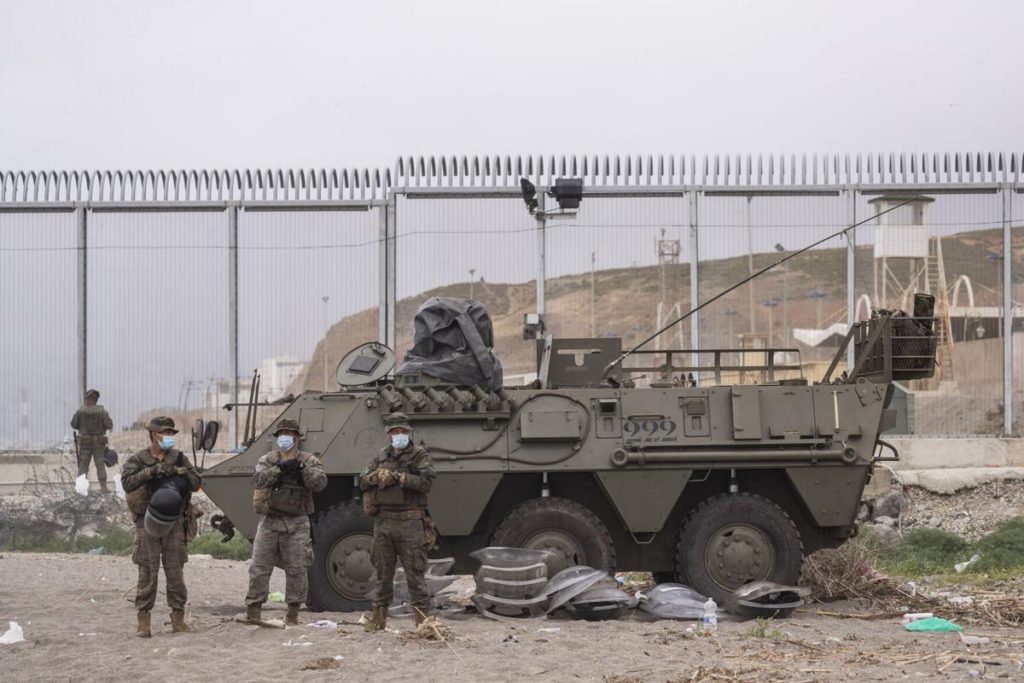
CEUTA, Spain (AP) — Officials in Ceuta, a Spanish enclave in north Africa, were getting flooded with calls from Moroccan parents while trying to speed up family reunions after hundreds of children and teenagers were swept up in a diplomatic storm between Spain and Morocco.


Minors who crossed into Spain take shelter inside an abandoned building in Ceuta, Friday, May 21, 2021. Spain says it has returned to Morocco over 6,600 of the more than 8,000 migrants who swam or jumped over border fences into one of Spain’s enclaves in North Africa this week. Social services in Ceuta were dealing with thousands of calls from Moroccan parents looking for their children and trying to speed up family reunions, said authorities in Spain’s north African enclave at the heart of a sudden humanitarian crisis and a diplomatic storm with Morocco. May 21, 2021
Mabel Deu, a local government minister and spokesperson for the autonomous city, said Friday that a hotline set up the day before had received 4,400 calls from desperate relatives seeking information.
So far, authorities have confirmed 438 unaccompanied minors were among more than 8,000 people who arrived in Ceuta from Morocco between Monday and Wednesday by scaling a border fence or swimming around it. Social service workers were checking the ages of many more young people who are in shelters or roaming the streets, Deu said.
“Our goal is that they reunite with their parents as soon as possible because we understand the anguish and worry of many families who don’t know where their children are,” she said. Morocco has taken back over 6,600 of the migrants who made it to Ceuta, Spanish authorities said. Entering the city put them in European Union territory, and hundreds of thousands of asylum-seekers attempt to reach Europe from Africa each year.
Many of the worried relatives calling the hotline are just a few miles across the border, in the Moroccan city of Fnideq. But stepped-up vigilance along an 8-kilometer-long (5-mile-long) border and the overwhelmed resources on the Spanish side making the reunions difficult.
Fatima Zohra told The Associated Press that other girls pushed her 14-year-old daughter to cross the border without her mother’s knowledge. Zohra said she spotted her daughter on social media in photos from inside the warehouse where Spanish officials are keeping the minors while they process them.
“Please help me find my daughter,” she said. “We always provided for her. We have money. Her father works in a private company.” Spain is legally obliged to care for young migrants until their relatives can be located or they turn 18. Authorities are deciding where in the Spanish mainland to distribute 260 of the ones in Ceuta, who are being transferred to make room for new arrivals.
But reunions are also proving difficult to bring about, Deu said. Some of the children told social services they really want to stay, even against their parents’ wishes. Others can’t get home soon enough.
“I want to leave this place. I don’t want Ceuta. I want Morocco,” AP reporters heard a girl crying at a center where makeshift cabins have been installed for the children. Save The Children, an international non-profit, said in a statement that speeding up the return of the minors should be done on a case-by-case basis and upholding the child’s safety and interests above everything else.
The humanitarian crisis started as Morocco and Spain were at odds over Spain quietly agreeing to provide COVID-19 care to a prominent Sahrawi leader fighting for the independence of Western Sahara, a territory once under Spanish control that Morocco annexed in the 1970s.
While blaming Spain for creating a diplomatic dispute by hospitalizing the leader of the Polisario Front, Moroccan authorities deny that they encouraged this week’s mass crossings to Ceuta. Witnesses and reporters, including AP’s, have described seeing the border guard relaxed. But at least two Moroccan officials have separately attributed the massive surge to favorable weather or a consequence of troops being tired following Ramadan celebrations.
“This was not improvised, it was planned. Morocco benefits by sending us and clearing people out,” an 18-year-old who crossed this week into Ceuta told AP. “They are clearing (pushing us out). We are Morocco’s experiment. We are like lab rats.”
The young asked for his name not to be disclosed for fear of deportation and other reprisals. There was no immediate comment from Moroccan authorities to questions submitted by AP. Adult migrants remaining in Ceuta were scattered between makeshift shelters and a migrant holding facility where some asylum seekers were taken. Many, especially Moroccans, were also roaming the streets, hiding from police patrols rounding up migrants and trying to find a way into the European mainland.
No more migrants arrived in the city without authorization for the third day in a row after Moroccan authorities stepped up vigilance on their side. However, security forces on both sides of the fence separation Morocco from Melilla – another Spanish territory in northern Africa – repelled groups of youths trying to reach Spanish soil. The government said at least 30 of them made it in.
Sovereignty claims over Ceuta and Melilla by Morocco have been an intermittent flashpoint between the two Mediterranean neighbors. But relations dipped to a low this month over Spain’s decision to provide medical treatment to Brahim Ghali, who leads the Sahrawi’s fight against Morocco’s annexation of Western Sahara.
A statement from the self-declared Sahrawi Arab Democratic Republic, which Ghali also leads, blamed Morocco on Friday for using “expansionist policies, aggression, and blackmail” in trying to push European countries toward accepting its claim to Western Sahara following the recognition the United States gave last year.
“The conviction by Moroccan diplomats that (former U.S. President Donald) Trump’s declaration could create a global dynamic to legitimize the annexation and illegal occupation of Western Sahara by Morocco resulted in a political fiasco,” the statement said.
Morocco has offered to grant wide-ranging autonomy to the territory, where one of the U.N.’s longest-running peacekeeping forces has monitored a cease-fire since 1991. The Polisario Front says the local population has the right to a referendum on self-determination.
Fighting occasionally flares up, most recently in late 2020, when the Moroccan military launched an operation in the U.N.-patrolled Guerguerat border zone to clear a road it said was blocked by Polisario supporters.
AP journalist Aritz Parra in Madrid contributed to this report.









SÍGUENOS


ARCHIVOS
- Noviembre 2026 (11)
- Octubre 2026 (10)
- Septiembre 2026 (19)
- Agosto 2026 (14)
- Julio 2026 (17)
- Junio 2026 (19)
- Mayo 2026 (34)
- Abril 2026 (18)
- Marzo 2026 (22)
- Febrero 2026 (15)
- Enero 2026 (18)
- Diciembre 2025 (20)
